Showing posts with label electrical mutate. Show all posts

Tuesday, March 25, 2025

MINOR SUPER-HERO ROUND-UP 042

Boys! Boys! Boys! Super powered boys!

Magno


Magno, aka the Miracle Man, aka the Magnetic Man, aka Tom Dalton, was a power line worker who died when he was shocked with 10 000 volts DC and then revived when he was shocked again with 10 000 volts AC. As a result, Dalton developed electromagnetic powers that he used to fly, simulate super strength when dealing with metal and create magnetic force fields. Not a bad deal.

Magno's Golden Age career was short and fairly undistinguished, and his main claim to fame is being the only one of the old Quality heroes to be killed off by Roy Thomas in All-Star Squadron to never be brought back (Magno's look also reminds me of Jericho of the Teen Titans for some reason, but that's hardly another claim to fame). (Smash Comics 013, 1940)

the Ray


I had a couple of issues of The Ray comics from the early 90s when I was younger and so have a tendency to think of the Ray as being a far more prominent character than he actually is - he's got to be fourth-tier at best, really (assuming that top-tier characters are the ones that everyone knows, your Batmans and Supermans, and second-tier are the ones that even a casual comics reader would consider essential. Third-tier and below is where you get into debating territory).

Regardless of his level of prominence, the Ray is actually Happy Terrill, a devil-may-care young reporter who signs on as crew in a balloon trip to the upper atmosphere and is... empowered? When he ventures out into a cosmic storm to secure some essential safety equipment. Honestly, as presented on the page Terrill could be assumed to have been replaced with some sort of cosmic entity but maybe I'm the only one who thinks that because it certainly isn't reflected in subsequent Ray lore.

Cosmic entity posing as human or no, the Ray is endowed with a startling array of powers, including at least partial invulnerability, the ability to become and travel along light, giant growth, a healing touch, light projection and telekinetic rays. At first, anyway - after a couple of issues he adopts more of a two-fisted adventurer persona whose main power is the ability to change between Happy Terrill and Ray identities and who occasionally remembers that he can fly and shoot rays of light at people.

A fairly consistent thing that I've noticed in depictions of the Ray post-Golden Age is a tendency to portray him as a very dour and serious guy, which seems a disservice to someone with the nickname "Happy." I suppose I must give it to those later scribes in that the Ray himself almost discards his Happy Terrill identity in his first adventure before eventually coming to his senses. Neither the reason for resuming life as Happy nor the process by which he explained how he made his way back from the upper atmosphere is shown on-panel, but I have to assume that being a super-hero 24/7 just gets boring after a while and he wanted to have a bit of a break. (Smash Comics 014, 1940)

Master Man


Master Man starts out as a weedy little kid, too small to play, who is gifted a magic vitamin pill by a kindly doctor and becomes incredibly powerful adult man. It's all there on his one-page introduction, but what's missing is one important detail: is this a gradual process like the Champ's origin, where he takes the vitamin every day and grows up big and strong, or did this little kid instantly transmogrify into a grown man, like a permanent Captain Marvel? I suppose that if Master Man really is a little kid in a man's body it would explain why his first act is to build a cool clubhouse on top of a mountain, presumably containing lots of slides and fireman poles instead of stairs. 

Being a Fawcett Comics character, Master Man is technically owned by DC Comics now, though they haven't yet bothered to trot him out of retirement, possibly because of his name, which sounds fascist enough that Marvel Comics has several full-fledged Nazi characters that use it. He would be an interesting character to use as a foil for Superman, since his powers are magic-based, but Captain Marvel does usually fill that role so we're unlikely to get a Master Man revival any time soon. (Master Comics 001, 1940)

El Carim:

One more crime-fighting-stage-magician-with-actual-magical-powers for the pile, El Carim ("miracle" backwards, as the caption box is at some pains to inform you at the start of every story) also subscribes to the same tuxedo and thin black mustache school of fashion as his contemporary Zatara, though the turban does make it easy to tell the two apart.


What sets El Carim apart from his contemporaries early on is the fact that his crime fighting is done with a series of magical items rather than with magical spells. He has a magical monocle that can deflect bullets (in what must be a very alarming manner, visually) and project illusions and which can be combined with a device called the Spectograph to scry distant locations. In addition, he has a super powerful magnet capable of plucking bullets from the air (useful for when he already has a headache from bouncing a few off of his eye, perhaps) and the Arrestor, which is able to freeze others in place, even against the pull of gravity.

Over time, El Carim starts slinging spells in a way more in line with the other magic men of comics, and I personally reckon that that's why he has languished in relative obscurity since the 1940s (other than an appearance in a 2016 issue of Scooby-Doo Team-Up, that is), as without that hook he is not appreciably different from any of his peers. (Master Comics 001, 1940)

Monday, February 3, 2025

MINOR SUPER-HERO ROUND-UP 038

Second- and third-tier Fox Features heroes: ACTIVATE

Dynamo:


Jim Andrews is an electrical scientist who heroically risks his own life by using his own body as a conductor to prevent some crazy bit of machinery from blowing the whole laboratory he works at to high heaven. And since he lives in a comic book world, the reward for his bravery is some super powers! He can now emit electricity, create an electrical forcefield, kind of fly by throwing a lightning bolt and then riding it through the air and even be super strong, with the minor caveat that he has to charge himself up from time to time (over time and for narrative convenience he also develops the powers to freeze water, to repair smashed up items by shooting electricity at them and to travel interstellar distances under his own power).

Andrews originally calls himself Electro but swaps that name out for Dynamo in his second appearance. There is some speculation that the name change comes about because there was already an extant Electro over at Marvel.

Dynamo's costume choices over his two years of adventuring range from "generic" to "kind of dumb-looking," and the real kicker is that the Fox Features cover artist consistently puts him in this incredible red number. (Science Comics 001, 1940)
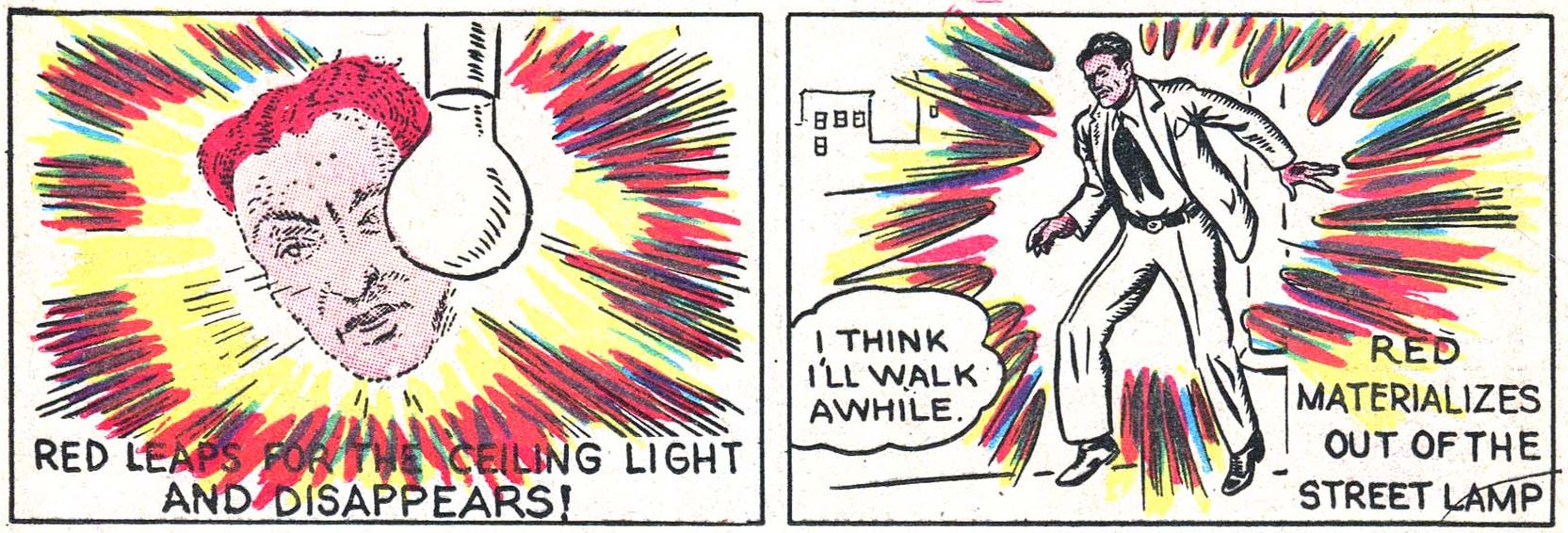

ADDENDUM: In Science Comics 005, Dynamo, already wildly powerful, invents a device with the fairly ominous name the Brain-Wave Trap which allows him to read the minds of everyone on Earth and indeed for hundreds of light years around. Ir's a significant power boost for something that is mainly used to keep the plot chugging along.

UPDATE: Weird Comics 1940

the Eagle:


The Eagle is Bill Powers, a wealthy young gadabout who has developed an "anti-gravitation fluid" which allows him to fly when applied to his wing/flaps.


The Eagle might just have the greatest number of costume variations before finding his groove, though I suppose a number of them can be ascribed to the whims of the colourist on any given day. While the flying squirrel style flaps are fun for their uniqueness and that fourth version has far nicer-looking wings than Hawkman was sporting at the same time I can absolutely understand the impulse to move toward a more traditional super-hero costume without a bunch of fiddly little feathers all over it. BUT! the Eagle's costume has not reached its final form - something to look forward to once we get to Fox Features' 1941 offerings. Or just look up on your own, I suppose.

I don't think that it's intentional so much as a product of many busy hands being involved in making most if not all Fox Features comics, but Bill Powers is one of the better realizations of the "wealthy young playboy" super-hero alter ego. He really and truly comes off as someone who is just kind of doing things, including fighting crime, to keep himself occupied and the greatest example of that is all the little projects such as his "crime cartoons" or his "book on crime" that he keeps mentioning once and then never ever returning to. Plus he has a butler named Jason, whom I love.

Finally, the Eagle might just have the most mysterious of all calling cards, an unseen "mark like that done by an eagle." (Science Comics 001, 1940) 

UPDATE: Weird Comics 1940

Marga the Panther Woman:

Marga, formerly a nurse at the asylum housing the mad physiologist von Dorf, finds herself kidnapped and made into a panther/ human hybrid. Is there just a hint of weird race science in the way that Marga going from blonde to black haired is a sign of her primitive nature being brought forward? Maybe just a skosh.


Marga adapts fairly well to her new situation, even when it means that she is now an obligate carnivore. She just kind of accepts that her life is no longer that of a nurse but that of a jungle predator.

Marga's first few adventures take place in what is pretty clearly the future but a series of comics with different creative teams ends with her being a contemporary 1940 figure. (Science Comics 001, 1940)

Navy Jones:

Navy Jones (and let me tell you I groaned audibly about two hours after I fist read that name, when I figured out that it was a pun on Davy Jones) is a submarine commander of the future who meets with disaster when his submarine hits a free-floating mine and everyone on board but him is killed. Lucky for Jones, he is picked up by some passing Fish-Men and taken to their city, where he befriends their king.

Things take a turn when the evil Prime Minister uses the presence of this outsider in the halls of power as a catalyst for rebellion, and Navy Jones is almost killed. In another stroke of fortune, the king happens to be a skilled surgeon and saves Jones' life at the cost of his ability to breathe air. Jones rescues the kidnapped Princess Coral from the Prime Minister and puts down the rebellion, becoming the city's champion (and in a final stroke of luck, the Fish-Men are the kind of comic book species where the more aristocratic you are, the more human you look, so Jones' new Princess love interest is barely a fish at all!). (Science Comics 001, 1940)

Friday, January 31, 2025

MINOR SUPER-HERO ROUND-UP 037

More cream rises from the milky depths of the Golden Age!

Red Roberts, the Electro Man:


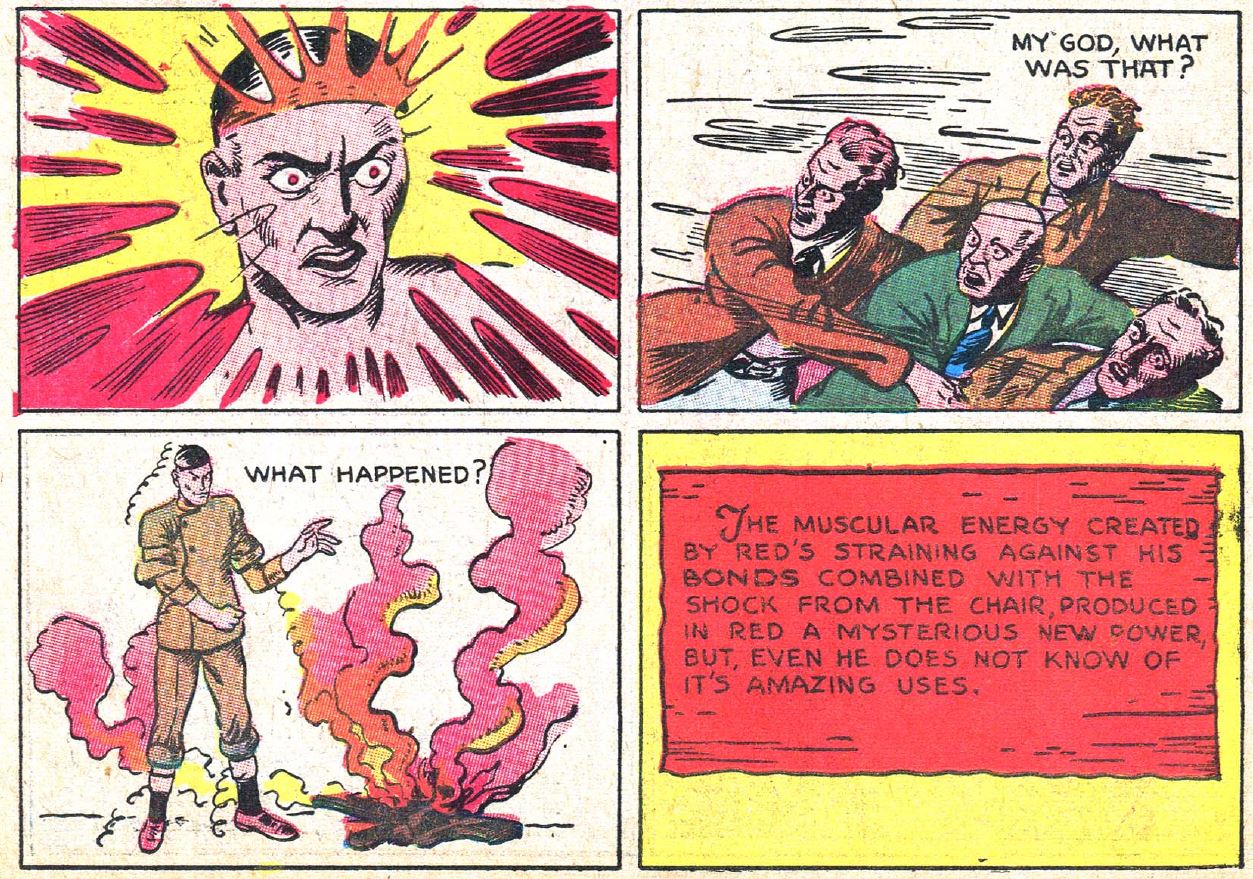
It's unclear what Red Roberts' actual job is, but he is a guy who Knows Too Much about the corruption in the unnamed city he lives in and so he is framed for murder and fast-tracked to the electric chair.


Luckily for Roberts, this is a comic book universe and being an innocent person sentenced to be executed via the electric chair means that you get sick-ass electricity powers instead of dying like everyone else. Red Roberts quickly parleys these powers into revenge on the city's crooked mayor and his cronies and then cleans up crime around town for a couple of issues more for good measure. He doesn't bother with a secret identity because at least half a dozen people were there to witness his origin, which must feel quite freeing. (Rocket Comics 001, 1940)

the Phantom Ranger:

There's not much to distinguish the Phantom Ranger from his contemporaries in the ranks of Mysterious Cowboys Who Stick Around Just Long Enough to Help Out, but here goes: his horse is named Demon and he likes to ride around with his sleeves rolled up, which gives him a business casual look that I appreciate. (Rocket Comics 001, 1940)

the Defender:

Is the Defender (Robert Larson, who was scarred facially by criminals as a child and who now fights crime using a malleable rubberoid mask and two dedicated assistants) a take on pulp and comic character the Avenger (Richard Benson, whose face was rendered inhuman by the shock of losing his wife and child to criminals and who now fights crime using his own malleable face and 4-5 dedicated assistants)? I certainly think he is, but I don't know if you could conclusively prove it. (Rocket Comics 002, 1940)

Samson UPDATE:

Samson being descended from the long-haired Biblical figure of the same name is not a new origin for the character, but once he had his own series it was time to explicitly lay it out in the form of his mother telling him in plain English that he is. Frankly, I'd much rather learn how he managed to get away with  having shoulder-length hair as a teenager in the early 1930s, but it's just left as an exercise for the reader to figure out.

No such luck for David, however. He remains an orphaned Boy Scout who Samson just found and adopted one day. David is not his actual name and we do not know his actual name. There is some early effort to play up his Boy Scout knowledge as valuable to the crimefighting enterprise but that soon falls by the wayside. (Samson 001, 1940)

Tuesday, August 6, 2024

MINOR SUPER-HERO ROUND-UP 022

There's a little super-hero in all of us, I reckon.

Volton

Volton comes on strong. I mean, look at the guy: crotch-forward, power device on a chain welded around his waist, moisturized, in his lane. The very second he figured out how to have super-powers he was in his element.

And because Volton (aka Guy Newton) HATES CRIME and HATES CRIMINALS he heads on down to the local police station in his only-the-most-confident-heroes-wear-them sweater vest and beats up cops until they let him be a semi-official vigilante. And he is much more qualified than the pack of ding dongs the Commissioner here has working for him - do any of them have electrically powered super strength or an electrical forcefield or the ability to suck the electricity out of a person to stun them? They do not. 

Volton does such a good job beating up crooks that not only does the Commissioner come around on him but lets Volton date his daughter. This is the workaround for those fathers who ostentatiously display a shotgun when the new beau comes around, fellows: vigilante justice. (Cyclone Comics 001, 1940)


Volton is our second encounter with a future member of Marvel's team of public domain super-heroes-turned-Nazis the Battle-Axis, and it's hard to say if Roy Thomas did him the most dirty or the least. His stated reasons for the heel turn are certainly the flimsiest of all the Battle-Axis members but just like his revised origin of having been struck by lightning they aren't actually true, as this version of Volton is a prototype of the same kind of android as the Human Torch, taken along when Dr Nemesis Death split from Phineas Horton after helping him create android life but before turning to fascism.

All this is interesting in a universe-building kind of way (the Human Torch has a little brother who hasn't showed up in decades! What's up with that?) but a bit of a missed opportunity in that the original version of Volton is more than a bit fascist. Why bother making the Human Meteor go Nazi for Ireland when you could have him be the android and simply let Volton follow his heart?

the Red Knight:

What can I say: I like super-hero-adjacent characters and stories of knightly adventure are full of those. The Red Knight, for example, is Sir Miles of Lorraine and he has special red chain mail! and that's about it. Even worse, his adventures are set during the First Crusade, so there are likely to be fewer dragons and evil warlocks and more historic war crimes heinous enough to still come up in international relations. Lucky for me, the Red Knight series only had two installments and the second one (the one more likely to have war crimes in it) is missing! As it stands, the Red Knight spends most of his energy dealing with his evil uncle rather than in slaughtering all and sundry. (Cyclone Comics 001, 1940)

Robo of the Little People:

Like Electro before him, Robo here is actually a super-powered robot piloted remotely by a scientist (in this case a guy named Vedik). The gimmick in Robo's case is that he was constructed as a giant robot by the inhabitants of an isolated Antarctic valley but once he started to explore the outside world for them it quickly became clear that his creators were in fact very small and Robo was the size of a regular human. 

Robo probably would have transitioned into regular super-heroing at some point but since he only has a handful of appearances most of his adventures are concerned with day-to-day survival in our wacky world. (Cyclone Comics 002, 1940)
The Eye:

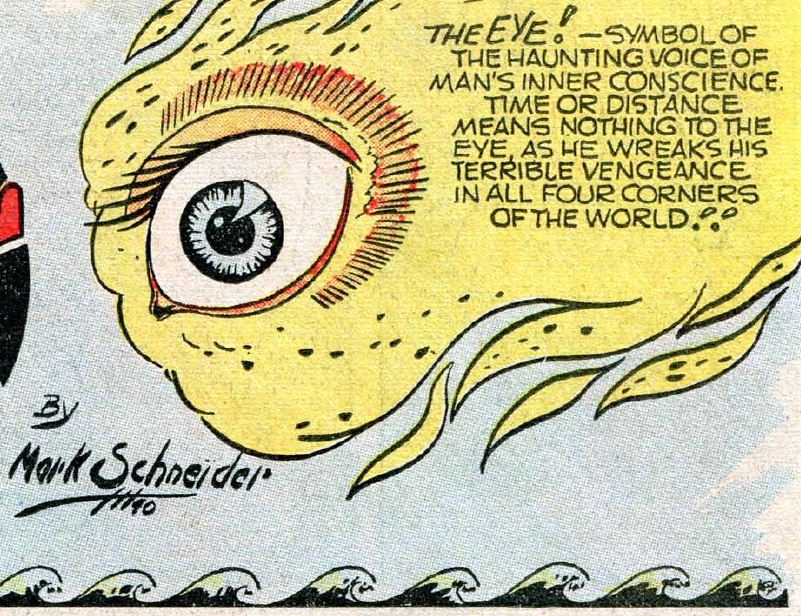
The Eye is just that: a huge, disembodied eye with associated lid, lashes, etc, that appears with or without a halo of flame to serve the cause of justice throughout the world. It is, without a doubt, an outlier in the group of beings that can be labelled "super-hero".


About the only thing that we know about the Eye is that it is a well-known figure world-wide. It's been operating for long enough that legends of its deed are present in a number of different cultures and whispered of by the criminal fraternity. Other than that: nothing. The Eye sees injustice and metes out justice and that's all.


Actually, there is one other thing we can infer about the Eye: either its power levels or its willingness to act directly varies over time. Sometimes, as above, it takes the shortest route to justice, employing heat rays and knocking planes out of the air willy nilly. Other times (and particularly by its last few appearances), the Eye contents itself with passing off information to human agents such as lawyer Jack Barrister. Is the Eye periodically short on power? Is it bored of the lack of challenge inherent in eye-beam based justice?

The Eye's eye also flips from left to right sometimes. This is actually quite eerie! (Keen Detective Funnies v2 012, 1939)

Monday, June 24, 2024

MINOR SUPER-HERO ROUND-UP 014

Some real niche characters this time.

the Lone Star Rider:

An Old West hero so generic he only appeared once and never even got to track down the owlhoots who killed his parents in order to steal their land. Good gloves. (Smash Comics 002, 1939)

Shock Gibson:


Like Barry Allen after him, Charles (later Robert) Gibson is a young scientist working late into a stormy night when he is simultaneously struck by lightning and bathed in chemicals. Though he is called the Human Dynamo, for the first chunk of his career he functions as more of a Human Battery who stores an electrical charge that can be used to fuel various superhuman feats - super-strength, super-jumping (later full-on flight), and a shocking grasp.

Shock Gibson goes through more than a few costume changes over the years - sadly this goofy helmet is axed during the first one - but one consistent element in his design is lotsa cool electricity crackle when he uses his powers. (Speed Comics 001, 1939)

Shock Gibson UPDATE 1940: He loses the hat.

the Man With 1000 Faces:


Ted Parrish, famous film star, is bored with his humdrum life and so turns his considerable talent for quickchange artistry and disguise to the task of crimefighting. Just where he gets all of his accessories from is not elaborated on, so it's equally likely that he scavenges them from the environment as it is that he just hauls around an enormous hockey bag full of clothing etc everywhere he goes.

Parrish's mission is obviously hampered somewhat by the fact that Los Angeles' criminal fraternity knows that the Man With 1000 Faces exists and they should be on the lookout for him. How did they find out? Did Parrish blab to up the challenge and excitement of it all? (Speed Comics 001, 1939)

the Wizard:

Blane Whitney, AKA the Wizard, is the latest in seven generations of Whitneys (some of whom were also called the Wizard) to dedicate their lives in patriotic service to the USA. Plus he was a child prodigy who was charged to use his abilities to better mankind by Woodrow Wilson. Plus he's an inventive genius in virtually all fields, particularly various forms of engineering. Plus he has nearly superhuman physical abilities and a mind so highly developed that it is superhuman in that he can employ remote viewing to locate dangers and clues.

The Wizard was a pretty big player at MLJ in the 40s but has largely been abandoned in the various attempts to revive the MLJ characters at Archie and elsewhere - his biggest post-Golden Age appearance that I am aware of was as a super-villain fighting the Mighty Crusaders in the 60s. What does this say about the character - that he's perfectly serviceable but not very conceptually exciting? Yes, I reckon that sums him up. (Top-Notch Comics 001, 1939)

UPDATE 1940a

UPDATE 1940b 

CATALOGUE OF WOUNDS 003

It's a dangerous ol' job, heroing. Green Lantern : While tied up in a burning house, Green Lantern must thrust his hands into the fl...