Showing posts with label 1936. Show all posts

Tuesday, November 18, 2025

DIVINE ROUND-UP 022

Oh my gosh this place has so many god options.

the Sacred Leopard


The animal-worshipping tribe who all dress like the animal in question is a regular trope in jungle comics so of course Kalthar, lord of the jungle eventually encounters some of them. In this case it's Leopard Men from the Leopard Village, who dress in leopard skins and worship Karno, the leopard (Karno seems to be the collective singular noun for the leopard, a thing that happens a lot in jungle adventure books. I'm sure that it happens in real-world language as well, just as I'm sure that most of the examples in comics are just arbitrarily made up). The Leopard Men attack Kalthar and his people because they are being manipulated by a slaver who has a vendetta against them, and end up minus a lot of leopards for their trouble.

God Style: Animist (Zip Comics 005, 1940)

Roor the Octopus God


After former Zatara foe Setap achieves her goal of regaining her youth, she reforms and starts looking to reconnect with her Atlantean roots by the simplest way possible: enlisting Zatara's help in finding the sunken city of Atlantis.

Everything is going great - Setap is welcomed with open arms, she and Zatara are learning why Atlantis sank (hit by a lost second moon, natch), etc - when one of the sailors they brought with them starts trouble while stealing everything not nailed down, as so often happens when an ancient civilization is discovered by sea. Specifically, the sailor enters the temple of Roor, the Octopus God, within which the giant and insatiable immortal octopoid was not so much worshipped as imprisoned.


Roor is free to lay waste to Atlantis, and not even the power of Zatara can touch him. The Atlanteans are justifiably upset by this.


Thankfully, the one magic that Zatara has that can affect Roor is that of illusion, by which means he fools the ancient/powerful/gullible god into eating a whole heap of sponge and salt and then exploding himself by drinking more water than he can contain. Atlantis is saved!

God Style: Real (Action Comics v1 018, 1939) 

the Sacred Oak


One of the earliest DC books, New Comics (which eventually becomes New Adventure and then just Adventure Comics) had among its many features an adventure strip called 'Vikings' which was kind of slow and dour like a lot of early comics but did feature these doily-hatted Druids and their Sacred Oak that communicates to them via stiff breezes.

God Style: Animist (New Comics v1 010, 1936) 

Shin-Giva


Shin-Giva is the god of the Dwarf People of Matto Grosso in Brazil, and his solid platinum idol is the focus of the attention of crooked explorer Frank Hart, who wants to steal it, and his former partner Henri Rinaldo along with Zatara, who want to return it to Shin-Giva's worshippers and do so thanks to Zatrara's mighty magicks (please note that the idol is not returned out of any sense that you shouldn't just waltz in and take valuables from less technologically-advanced societies but rather out of a desire to not crash the world platinum market. So noble!).

God Style: Idol (Action Comics v1 033, 1941) 

Monday, October 13, 2025

DIVINE ROUND-UP 016

Gods aplenty! 

Tyalpo


The god worshipped by Ibis the Invincible villain Piang the Terrible. Probably real, in that Piang has real magical power that he calls upon Tyalpo to activate, even if the god himself shows up only in idol form.

God Style: Idol (Real?) (Whiz Comics 009, 1940) 

Goddess of the Jungle


Sandor is a jungle hero who doesn't so much adventure as get into one long series of scrapes and situations in Northern India, the second most popular location to be a jungle hero by my reckoning. One of those scrapes involves him nearly getting sacrificed to the Goddess of the Jungle, about whom we never really learn more than her name. 

God Style: Invoked (New Comics 006, 1936)

the Golden Dragon


"The Golden Dragon" is a serial that ran in Adventure Comics for around three years (and in fact started back when the book was called New Comics), about a group of adventurers and soldiers of fortune travelling from China to Mongolia in search of the fabled treasure of the Golden Dragon, while fending off attempts by the villainous Torgadoff to halt their journey, presumably so that he can seek the treasure himself. 

Adventure Comics 034 finds de facto expedition leader Ian Murray at the end of the trail, which turns out to be a very much still in-use Temple of the Golden Dragon, with Torgadoff turning out to be one of the high priests. Does this dampen his desire to strip the place of its treasure? Absolutely not! This is a 1930s adventurer we're talking about! The presence of a non-Christian religious practice only increases his lust for gold!


Even the treasure-hungry Murray is taken aback, however, when the Golden Dragon shows up and turns out to be a real, living creature - presumably some sort of giant snake rather than a more traditional dragon based on how dumb it seems to be. 

Murray's reverence for this wonder of the natural world extends about as far as his respect for other cultures, and he ends up blasting the Golden Dragon at the first opportunity (but not before tossing Torgadoff into it's crushing coils). The death of their god causes the worshippers to retreat, and the heroic adventurers are able to loot the temple and retire to lives of ease and luxury.

God Style: Animist (Adventure Comics 034, 1939) 

the Golden God

The Golden God is one of the innumerable gods worshipped by the uncountable made-up Amazon tribes that comics are full of, and like so many of these gods, the Golden God is sought out by adventurers because it is represented by an idol of solid gold. Heroic adventurers the Companions Three seek out the idol after being hired by a woman named Cassie Bennett to find her father, Professor Bennett, who is supposedly after it on anthropological grounds 

As usual, the anthropological value of an artifact outweighs the fact that the idol in question is still being used, but that turns out to matter a bit less than it normally does because the Golden God has in fact been discarded in favour of an unnamed new god, This new god in turn is revealed to be the Companions' antagonist Hook Harroday, who is himself after the gold.


Harroday's plan to messily murder the Companions Three falls apart under a barrage of punches, and the group escapes with the idol of the Golden God, which Professor Bennett sells to a museum in a real triumph for selfless anthropology. 

God Style: Idol (Master Comics 015, 1941) 

Wednesday, October 1, 2025

ALIENS AND SO FORTH ROUND-UP 019

Today we have, per usual, something from the comic I'm currently reading followed by some stuff from the archives. It's a good system!

Glompers


We first meet the Glompers on the planet Venus after Dr Sivana has tricked Billy Batson and by extension Captain Marvel into joining him on an experimental rocket trip, with the intention of killing and/or stranding him there. They are immediately the most charming aliens I have ever seen, despite or perhaps because of the fact that they are just large frogs wearing trunks and little conical hats.


The Glompers are ruled over by Beautia, Empress of Venus (later revealed to be Sivana's daughter), and again I must emphasize just how friggin' charming they are. Just look at his little spear! (Whiz Comics 003b, 1940)

Sadly, as far as I can tell the Glompers only reappear one other time, as part of a plan by Dr Sivana to unleash them on Earth (Whiz Comics 015, 1941). The reformed-except-for-occasional-bursts-of-filial-duty Beautia expounds on the Glompers somewhat, revealing that they, like terrestrial frogs, are rapacious carnivores. Still charming! 

In conclusion, since as far as I know the current DC Universe does not have a canonical native species on Venus and I have to say that I think that the Glompers should fill that roll. Make 'em big ol' acid-spewing frog men!

Alligator Men/Mermaids


Rod Rian is an officer of Earth's Sky Police in the year 2500 CE who finds himself on the planet Mephistos, having adventures among the various intelligent species that reside there. Perhaps the least explored of these are the friendly Alligator Men, who either coexist with a species of Mephistan mermaids or are yet another species with extreme sexual dimorphism. Either way: love a reptile man. (Flash Comics v1 011, 1940)

Amazons of the Winged Death


Don Drake, like Rod Rian, is an Earth man who finds himself on an alien world populated with all kinds of different species of intelligent life, in his case the planet Saro. Unlike Rod, Don's adventures take place in the then-present day of 1935.

The Amazons of the Winged Death are, as the name suggests, statuesque humanoid females. They ride horrible insects (the Winged Death of the name, natch) and are generally hostile, though Don does manage to ally with at least a few of them. (New Fun Comics 004, 1935)

the Ape Men


Brad Hardy, like Rod and Don, is an adventurer who finds himself in a world full of strange and often hostile creatures. Like Don, he is contemporary to the comic that he appears in, but unlike both of them, the world he finds himself in exists on Earth, in a cavernous realm below Mongolia. 

The Ape Men (also Ape-Men and Apemen) are pretty typical: monkey faced humanoids with tails and a bad attitude. I do enjoy their Living Ape-God, who seems to just be the largest Ape Man. (More Fun Comics 009, 1936)

Thursday, December 12, 2024

REAL PERSON ROUND-UP 007

It's a bumper crop of real people (and famous fictional ones) showing up in comics!

Adolf Hitler:

This is very, very tenuous but this adventure story is concerned with a hunt for mythical man-goat lycanthropes known as "weredolfs" and I'll be danged if I can think of a reason for them to be called that other than as a very oblique jab at Adolf Hitler. (Hyper Mystery Comics 001, 1940)

Less tenuous: when Cartho (one of the seemingly limitless number of lost empires dotting the jungles of Africa) attempts to invade Camilla's Lost Empire, its jerk of a leader is of course named Hitlo. (Jungle Comics 010, 1940)

Mias here is the leaser of a small Asian country that has set its sights on conquering the Philippines. He's a pastiche of 40s dictators but his Hitlerian traits shine brightest. (National Comics 003, 1940)

FDR:

Minor appearances:

Congratulates Wonder Boy for helping some farmers (National Comics 005, 1940)

the Forty Thieves:


It's never really explained how, but the Forty Thieves of Arabian Nights fame steal the Ophar Jewel from a lady in modern London and Merlin the Magician heads back in time to get it back with the help of a contemporary Cockney street gang. (National Comics 004, 1940)

Jack Dempsey:

Former boxing champ Jack Dempsey and his New York restaurant pop up with a fair frequency in 1940s comics, particularly ones featuring boxers such as Kid Dixon here. Why he and other boxers tended to show up under their own names rather than under flimsy pseudonyms like "Dack Jempsey" is a mystery - although I suppose that the real life boxing community had already proven to be okay with showing up in the "Joe Palooka" comic strip so perhaps comics creators assumed that they would be fair game. (National Comics 003, 1940) 

John D Rockefeller:

Minor appearances:

Never-seen millionaire and target of criminal scientist von Lohfer is by context clues an analog of Rockefeller. (National Comics 005, 1940)

Michael Malloy:


The story of Michael Malloy, the seemingly unkillable man targeted by a gang in a life insurance racket, is an evocative one, so it's unsurprising to see it crop up as a comic book plot here and there. Happily for Malloy's in-story equivalent Milligan, the gang is rounded up by comic book artist/ detective Pen Miller before they are finally able to overcome his iron constitution. (National Comics 002, 1940)

Neville Chamberlain:

The Kid Patrol, a mid-to-low-tier kid gang, encounters this clearly allusive lad, Sir Chamberlain Bumbershoote by name, while they are being pranked and vexed by another gang. Weirdly, though Bumbershoote's talk of appeasement and attempt to get a signed nonaggression pact with this very Hitlerian gang leader are presented derisively he himself is a formidable figure who routs the entire gang with his trusty umbrella. Neville Chamberlain must have been hovering precisely on the precipice of becoming an historical punchline when this one was published. (National Comics 006, 1940)

Ruby Keeler:

Hollywood comic strip 'Olly of the Movies,' well into its second year, was overdue for some gratuitous movie star cameos so actress Ruby Keeler just kind of shows up on a beach along with Dick Powell and Busby Berkeley. Everyone says hello and then parts ways. (Famous Funnies 023, 1936)


The gratuity continues in the next issue, with perfunctory appearances by Hugh Herbert, Joan Blondell and Zasu Pitts, and with Guy Kibbee in a very minor role in the actual plot. (Famous Funnies 024, 1936)

(Famous Funnies 024 also features this crowd of what are presumably supposed to recognizable Hollywood faces but I can only identify Bing Crosby in the yellow sweater vest and then only because someone did an impression of him on the previous page. Bub bub boo!)

Sherlock Holmes

They may not have given him a parody name, but Dinky Dinkerton here is clearly a Holmes parody comedy character, aided by Doctor Philip Anbust (aka Sniffy) in the Watson role (the third member of the trio, secretary Flossie, is not a Holmes character parody but is the brains of the operation, something that Holmes pastiches often leave out, to their ultimate detriment). (Reg'lar Fellers Heroic Comics 001, 1940)

Another broad Sherlock Holmes pastiche is the unfortunately-named-to-modern-eyes Fuller Spunk, who is actually an actor known for playing "Herlock Olmes", so perhaps he is more of a reference to Basil Rathbone. (interesting to note that the character of Marcel was originally bringing "female impersonation" to the group but that that skill was tossed aside in favour of a suite of stage magician tricks) (Hyper Mystery Comics 002, 1940)

Shoshenq I:

In Jungle Comics 011, previously straightforward jungle explorer Roy Lance goes nuts for discovering the mystic secrets of the pharaohs* and specifically for finding the genie-controlling power of Sheshonk. Who is Sheshonk, you ask? Why, he is better known as Pharaoh Shoshenq I, more famous than he might otherwise be because he is associated with the Biblical figure Shishak who warred against Solomon and looted the treasures of the Temple - he is mentioned as having been the one to hide away the Ark of the Covenant in Raiders of the Lost Ark, for example. (Shoshenk I is also a candidate to be the father of an Egyptian princess married to Solomon, which the story alludes to by calling him "father-in-law to King Solomon")

*based on the fact that both the Roy Lance and Red Panther stories in Jungle 010 were out-of-context sci-fi adventures and that the Simba story in 009 was made up of repurposed panels from earlier Simba stories I suspect that Fiction House had gotten a bit behind and were renaming characters in any old stories they had spare in order to make deadlines.

This story also features two other possible allusive figures: Lance's doomed companion Lord Carvon seems likely to be a reference to Lord Carnarvon of the Curse of King Tut fame, while "Tera Bey, Mistress of Mysteries" is a figure as evocative as she is elusive. Literally the only thing I have been able to come up with is the possibility that she is a reference to Queen Tera, mysterious ancient mummy from the Bram Stoker novel The Jewel of Seven Stars, but it's equally likely that she is a made-up bit of deus ex machina to get our heroes out of a sealed tomb. (Jungle Comics 011, 1940)

Thursday, June 6, 2024

MINOR SUPER-VILLAIN 537: THE SILVER FOX

(Funny Pages v1 007, 1936)


Dastardly desert bandit who bedevils scientist Fred Murray and his children Jimmie and Norrie as they search Egypt for the Sapphire Eye of Sehkmet. He's a pretty basic type villain but I have some affection for these pulp-style fellows as we start to get away from them. Note also the all-purpose accent he's sporting, which was definitely the go-to for Golden Age creators who didn't know what, say, an Egyptian sounded like.

As far as I know (taking into account Centaur Comics' tendency to shuffle features in and out of their various anthology titles in a fashion that I would describe as willy-nilly) the "Sapphire Eye of Sehkmet" feature never actually wrapped up, so the Silver Fox joins our collection of villains who have escaped justice via publishing and business decisions.

Monday, January 8, 2024

MINOR SUPER-VILLAIN 418: THE RED HOOD GANG

(Funny Picture Stories v1 003, 1936)


These guys are a bunch of dipshits, but they're kind of lovable. They kidnap reporter Red Dolan to keep him from exposing their murder operation and basically give him a guided tour of exactly how to own them. Look, here's some tear gas! Now we'll all go into a different room while you overpower your guard. Buncha goofs.

Thursday, April 6, 2023

Saturday, October 15, 2022

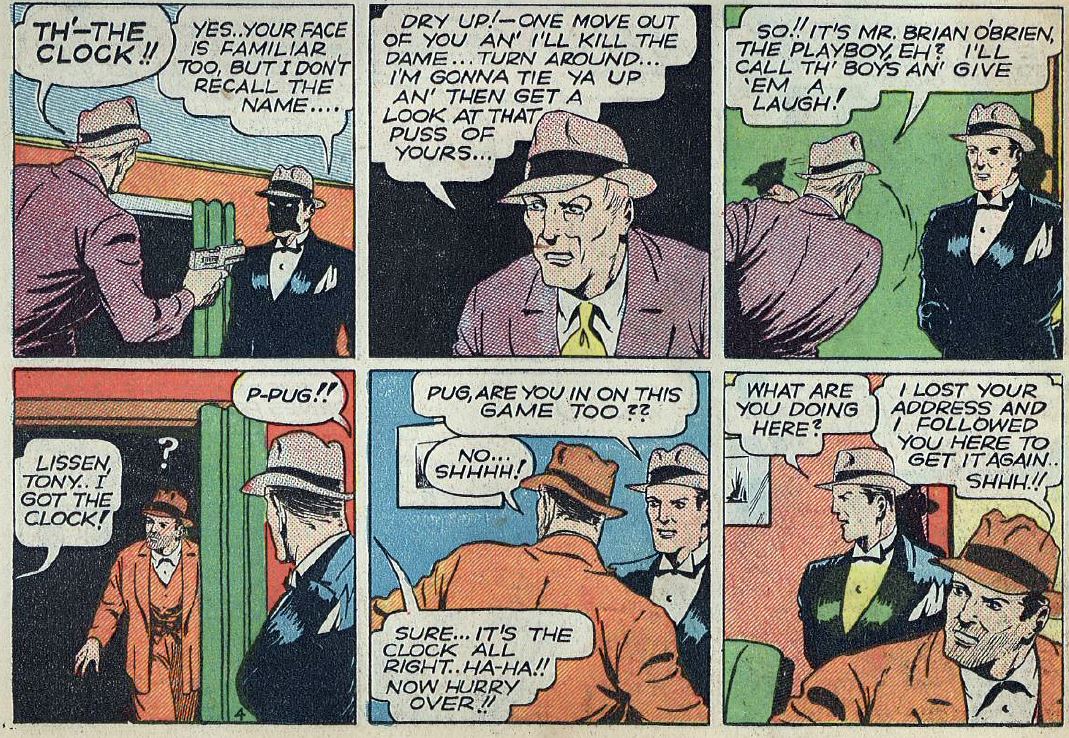
MINOR SUPER-HERO 019: THE CLOCK

(Funny Picture Stories/ Funny Pages/ Feature Comics/ Crack Comics, 1936-1944)


The Clock has the distinction of probably being the earliest masked crimefighter and definitely that of being the earliest one to stick around, which would make him the earliest super-hero if Dr Occult hadn't made his debut in 1935. A lot of the details about him are fairly cliché, both because they were cribbed from existing pulp clichés and because the Clock helped define the clichés of the genre.

So: Brian O'Brien is a wealthy playboy who puts on a tuxedo and mask and fights crime at night. He leaves calling cards for his foes, is often thought to be a criminal himself and is friends with police Captain Kane in his civilian identity while enjoying a somewhat fraught relationship with him while masked.


Over the years the Clock has a few different associates - above find Pug Brady, a down-on-his-luck guy who happens to look just like Brian O'Brien. They team up for a couple of years until Pug is unceremoniously chucked for a tough orphan girl named Butch about whom I know almost nothing, so it's a bit of a qualified statement when I say that by far my favourite member of the Clock family is the Orchid:


The Orchid appears a handful of times and her gimmick is that she is also a crimefighter, and one who is slightly more on-the ball than the Clock: she may know his secret identity, she can always get a message to him and most of the time she disappears at the end of a case, with the exception of the time she was distracted by her own kidnap-victim father. The Orchid only makes a handful of appearances but she's a winner in my books: bring her back, I say - fold her into the backstory of the Black Orchid!

So: the Clock is a solid Golden Age strip. Sadly, he will likely never see the light of day again. DC owns roughly seven dozen masked adventurers in suits and included in that number is Midnight, who would be a straight palette-swap of the Spirit if they had bothered to give him a different-coloured suit. Thusfar, he's the one they pull out in the rare cases that a suited crimefighter who isn't early Sandman is required, while the Clock and the Mouthpiece and Destiny and Just n' Right and Devil's Dagger and Diamond Jack and Cosmo, Phantom of Disguise all twiddle their thumbs in purgatory.

MINOR SUPER-VILLAIN 992: THE VAHINES

(Jungle Comics 013, 1941) The Vahines, aka the Tiger-Women of Wildmoon Mountain, have a plan: kill every other woman in the world, which wil...