Showing posts with label Merlin the Magician. Show all posts

Friday, January 2, 2026

DIVINE ROUND-UP 025

Gods gods gods. 

Puni, God of Fire


Sea-faring adventurer Lance O'Casey almost gets sacrificed to this fire god by the cannibalistic inhabitants of a tropical Antarctic island before escaping, entering the volcano in question and meeting the other Puni. Not sure how much the volcano-dwelling madman and the actual religion influenced each other, but it must have been at least a little. Also: cool idol.

God Style: Idol (Whiz Comics 019, 1941) 

the War God:

This War God idol functions like one of those hollow dog statues you see at grocery stores, that you put your change in to help raise money for people to get seeing eye dogs (and if that's not a thing where you live then sorry for the unrelatable analogy), only the money is meant to go to the defense of China against Japanese invasion, and instead of a dog it is a sick-ass god-monster. It's never entirely clear if this is supposed to be a representation of an actual god or just a marketing gimmick.

God Style: Idol (More Fun Comics 059, 1940)

 Wotan:


As was established when he beat up Mars that one time, Merlin the Magician hates war, and seeing as he has a magic cloak and a can-do attitude he sets out to do something about it. His first step is to go back in time and save a couple of young Ancient Britons from being human sacrificed by some Druids. What does this have to do with ending war? No idea, but then again I don't have a magic cloak so my perspective might just be too mundane to comprehend the intricacies.


Having reviewed the plan, I must conclude that Merlin just needed a couple of people with no ties who would be grateful enough to him to do whatever he wanted and that Druidic sacrifices were his first thought. Specifically, he asks these young folk to act as peace ambassadors to an unnamed fascist nation in order to undermine the efforts of the war god Wotan, who has been roaming the Earth inciting men to war.

(It would have been quite thematically satisfying if the two young people had been rescued from being sacrificed to Wotan, and while that might have implicitly been the intent, it's just not there on the page) 


The young people are somewhat successful, in that they are immediately killed by a similarly young and idealistic pair of enemy soldiers (and what a progressive fascist nation, to field female soldiers in 1941!) who then become overwhelmed with remorse and swear of war forever, at which point Merlin appears and restores his agents to life - an effective but painful strategy, it seems.

All this talk of pacifism and understanding between nations draws the ire of Wotan himself, who shows up to kill Merlin and ends up on the end of a killing sword-blow from the magician, making the current score Gods: 0 Merlin the Magician: 4.

God Style: Real (National Comics 011, 1941)

Death


This version of Death is bound to obey an artifact known as the Sceptre of Eternity, and as such has been commanded to replace the lost daughter of a guy called the Sheik of Kamroon in the 12th Century, and as such has made off with a present-day woman named Betty Jekil. I'm pretty sure that this was a calculated move, as Betty's father turns to super-magician El Carim for help, which ultimately results in El Carim trading the Sceptre of Eternity for Betty's life, which is a pretty good deal for Death.

God Style: Anthropomorphic Personification (Master Comics 019, 1941)

Sunday, January 12, 2025

MAD AND CRIMINAL SCIENTIST ROUND-UP 014

Don't bother asking to see their degrees.


This unnamed scientist has been kidnapping preteens and changing them into hulking brutes via some pretty fantastical brain surgery. He of course gets his ass fatally handed to him by the Red Panther but not before he goes on about producing a new super race and as always I have to question your devotion to science if you think that your physical alterations to these kids are going to be passed on. Who are you, Lamarck? You're going to be performing brain operations on babies all day every day. (Jungle Comics 009, 1940)

Von Blumb is a scientist who is saved from death and treated well by Camilla in her Lost Empire, then heads off into the wilderness to further his research. When he doesn't return after a few weeks, Camilla and Sir Champion head out to check on him and he repays their consideration by capturing them and subjecting them to his reducing serum and adding them to his collection of unwilling subjects. Long story short, they get loose, defeat his pet spider in gladiatorial combat and he gets squashed by a rock. (Jungle Comics 012, 1940)

Von Lohfer is a scientist with a grudge against John D Rockefeller stand-in J B Rockland, who called him a fake and ruined his life. But if Rockland was claiming that von Lohfer was unable to mind control a bunch of cops into doing his bidding he was dead wrong, because that's just what he does until he is ultimately stopped by Quicksilver. (National Comics 005, 1940)


Dr Morbidd has a great name and a really remarkable facial deformity, and he's been using science to raise people from the dead to do his bidding. This is all solid stuff but it doesn't amount to much actual super-villainy. There's some allusion to Morbidd's science zombies being sent out to do murders but the major thing he seems to be interested in is being a real creep to this one young woman he has captured. It would be quite narratively satisfying if he met his end at the hands of his own creations, but sadly he gets his head blown clean off when Merlin the Magician reflects his own death ray beam back at him. (National Comics 005, 1940)

Thursday, December 12, 2024

REAL PERSON ROUND-UP 007

It's a bumper crop of real people (and famous fictional ones) showing up in comics!

Adolf Hitler:

This is very, very tenuous but this adventure story is concerned with a hunt for mythical man-goat lycanthropes known as "weredolfs" and I'll be danged if I can think of a reason for them to be called that other than as a very oblique jab at Adolf Hitler. (Hyper Mystery Comics 001, 1940)

Less tenuous: when Cartho (one of the seemingly limitless number of lost empires dotting the jungles of Africa) attempts to invade Camilla's Lost Empire, its jerk of a leader is of course named Hitlo. (Jungle Comics 010, 1940)

Mias here is the leaser of a small Asian country that has set its sights on conquering the Philippines. He's a pastiche of 40s dictators but his Hitlerian traits shine brightest. (National Comics 003, 1940)

FDR:

Minor appearances:

Congratulates Wonder Boy for helping some farmers (National Comics 005, 1940)

the Forty Thieves:


It's never really explained how, but the Forty Thieves of Arabian Nights fame steal the Ophar Jewel from a lady in modern London and Merlin the Magician heads back in time to get it back with the help of a contemporary Cockney street gang. (National Comics 004, 1940)

Jack Dempsey:

Former boxing champ Jack Dempsey and his New York restaurant pop up with a fair frequency in 1940s comics, particularly ones featuring boxers such as Kid Dixon here. Why he and other boxers tended to show up under their own names rather than under flimsy pseudonyms like "Dack Jempsey" is a mystery - although I suppose that the real life boxing community had already proven to be okay with showing up in the "Joe Palooka" comic strip so perhaps comics creators assumed that they would be fair game. (National Comics 003, 1940) 

John D Rockefeller:

Minor appearances:

Never-seen millionaire and target of criminal scientist von Lohfer is by context clues an analog of Rockefeller. (National Comics 005, 1940)

Michael Malloy:


The story of Michael Malloy, the seemingly unkillable man targeted by a gang in a life insurance racket, is an evocative one, so it's unsurprising to see it crop up as a comic book plot here and there. Happily for Malloy's in-story equivalent Milligan, the gang is rounded up by comic book artist/ detective Pen Miller before they are finally able to overcome his iron constitution. (National Comics 002, 1940)

Neville Chamberlain:

The Kid Patrol, a mid-to-low-tier kid gang, encounters this clearly allusive lad, Sir Chamberlain Bumbershoote by name, while they are being pranked and vexed by another gang. Weirdly, though Bumbershoote's talk of appeasement and attempt to get a signed nonaggression pact with this very Hitlerian gang leader are presented derisively he himself is a formidable figure who routs the entire gang with his trusty umbrella. Neville Chamberlain must have been hovering precisely on the precipice of becoming an historical punchline when this one was published. (National Comics 006, 1940)

Ruby Keeler:

Hollywood comic strip 'Olly of the Movies,' well into its second year, was overdue for some gratuitous movie star cameos so actress Ruby Keeler just kind of shows up on a beach along with Dick Powell and Busby Berkeley. Everyone says hello and then parts ways. (Famous Funnies 023, 1936)


The gratuity continues in the next issue, with perfunctory appearances by Hugh Herbert, Joan Blondell and Zasu Pitts, and with Guy Kibbee in a very minor role in the actual plot. (Famous Funnies 024, 1936)

(Famous Funnies 024 also features this crowd of what are presumably supposed to recognizable Hollywood faces but I can only identify Bing Crosby in the yellow sweater vest and then only because someone did an impression of him on the previous page. Bub bub boo!)

Sherlock Holmes

They may not have given him a parody name, but Dinky Dinkerton here is clearly a Holmes parody comedy character, aided by Doctor Philip Anbust (aka Sniffy) in the Watson role (the third member of the trio, secretary Flossie, is not a Holmes character parody but is the brains of the operation, something that Holmes pastiches often leave out, to their ultimate detriment). (Reg'lar Fellers Heroic Comics 001, 1940)

Another broad Sherlock Holmes pastiche is the unfortunately-named-to-modern-eyes Fuller Spunk, who is actually an actor known for playing "Herlock Olmes", so perhaps he is more of a reference to Basil Rathbone. (interesting to note that the character of Marcel was originally bringing "female impersonation" to the group but that that skill was tossed aside in favour of a suite of stage magician tricks) (Hyper Mystery Comics 002, 1940)

Shoshenq I:

In Jungle Comics 011, previously straightforward jungle explorer Roy Lance goes nuts for discovering the mystic secrets of the pharaohs* and specifically for finding the genie-controlling power of Sheshonk. Who is Sheshonk, you ask? Why, he is better known as Pharaoh Shoshenq I, more famous than he might otherwise be because he is associated with the Biblical figure Shishak who warred against Solomon and looted the treasures of the Temple - he is mentioned as having been the one to hide away the Ark of the Covenant in Raiders of the Lost Ark, for example. (Shoshenk I is also a candidate to be the father of an Egyptian princess married to Solomon, which the story alludes to by calling him "father-in-law to King Solomon")

*based on the fact that both the Roy Lance and Red Panther stories in Jungle 010 were out-of-context sci-fi adventures and that the Simba story in 009 was made up of repurposed panels from earlier Simba stories I suspect that Fiction House had gotten a bit behind and were renaming characters in any old stories they had spare in order to make deadlines.

This story also features two other possible allusive figures: Lance's doomed companion Lord Carvon seems likely to be a reference to Lord Carnarvon of the Curse of King Tut fame, while "Tera Bey, Mistress of Mysteries" is a figure as evocative as she is elusive. Literally the only thing I have been able to come up with is the possibility that she is a reference to Queen Tera, mysterious ancient mummy from the Bram Stoker novel The Jewel of Seven Stars, but it's equally likely that she is a made-up bit of deus ex machina to get our heroes out of a sealed tomb. (Jungle Comics 011, 1940)

Friday, December 6, 2024

MINOR SUPER-VILLAIN 677: MARS

(National Comics 001, 1940) 


Once Jock Kellog decides to turn his back on his playboy ways and put his inherited magic cloak to use as Merlin the Magician, he really goes for it. He hits the battlefields of WWII to aid the beleaguered soldiers of the front and ultimately rises into the realm of the gods to confront Mars, God of War and Destruction himself. 

Mars turns out to be a huge jerk bully who is inciting nations to fight for his own amusement - a bit more Ares than Mars to be honest but I'll let it go.


Eventually, Merlin and Mars engage in Thrilling Hand to Hand Combat with the continuation of the war as the stakes, and after some back and forth that is cleverly mirrored in the progress of some armistice talks, Merlin wins! World War Two is over! As usual, this kind of "war can and will be avoided" story is very depressing in hindsight.

But wait, there's more! As in any story involving gods, demons and so forth, there is a high chance of some of my favourites the anthropomorphic personifications showing up, and show up they do! First off, Merlin encounters the embodiment of Peace chained to a bunch of weaponry like something out of a political cartoon and pledges to free her.


Merlin also has to battle Mars' henchmen Hunger and Poverty before he can get to the main event, and while there is a certain logic to the two of them making a person more susceptible to being either the perpetrator or victim of war I am sad that they don't have a bit more allegorical oomph. Why couldn't Hunger use those big fangs of his to sap Merlin's life force or something? Still, even a bargain basement anthropomorphic personification is an anthropomorphic personification and I love me some anthropomorphic personifications. Hunger and Poverty can stay. The guys, not the things that they stand for. Those suck.

Thursday, December 5, 2024

MINOR SUPER-HERO ROUND-UP 031

Great guns! More of them?

the Masked Angel:

Steve Oakes, wealthy playboy just so happens to also be the Masked Angel, vigilante feared by the underworld and wanted by the police.

Steve's father Detective Inspector John Oakes was murdered by crooks, so the Masked Angel act is his way of getting back at the criminal fraternity. It also seems to be a way to troll his brother, Detective Inspector John Oakes II, who is an asshole and who hates the Masked Angel in your classic way that a police officer does when they're part of a vigilante's supporting cast. Also please note the fun "angel shooting a gun" signature on the Masked Angel's taunting note. (Miracle Comics 001 1940)

Uncle Sam:

We're skirting the edge of what might be considered "minor" here, at least to DC Comics fans, but I have no Median Super-Hero category and however you slice it your parents almost certainly have not heard of him so here goes:

Uncle Sam is the physical embodiment of the patriotic ideal of the United States: good, kind, powerful and just. He emerges to lend a physical hand in times of turmoil by inhabiting of reshaping the body of a recently slain patriot.

This time around, Uncle Sam is (implicitly, all of this isn't really spelled out until later) reborn from the death of Ezra Smith, who stands up to fascist agitators the Purple Shirts and gets a bullet in the back for his trouble. He sticks around to beat Axis ass for the duration of the war and then is not seen again until DC integrates the Quality characters into Earth-2 continuity in the 1970s. (National Comics 001, 1940)

National Comics 005 expands the Uncle Sam lore slightly, firstly by making it a bit more explicit that he incorporates the spirits of dying patriots into himself with what is perhaps the initial time he did so, when a man named Sam sacrifices his own life to advance the cause during the American Revolution.

Secondly, Sam is seen merging with a living patriot named Samuel in order to help drive the fascist Black Legion out of Glen Valley. Is this a common event? Does Uncle Sam roam the land absorbing patriots? Who can say, but it certainly would put a new spin on the character.

Buddy Smith:

When Ezra Smith is murdered by the Purple Shirts, his grandson Buddy is left alone, presumably some sort of double-orphan. He is almost immediately found, shamed for crying, and adopted by Uncle Sam (and hopefully the near immediate recovery Buddy has from the grief of seeing his grandfather gunned down in front of his eyes is a function of Uncle Sam being partially Ezra Smith and not some sort of deep traumatic repression left to fester in his soul).

Buddy fills a pretty standard kid sidekick role: getting into trouble, getting Uncle Sam out of trouble, inventing things, befriending people, spotting clues, etc. He is unusual in that he is one of the few kid sidekicks who is a proper kid as opposed to being a young teenager (I know the common wisdom is that Dick Grayson was eight when he became Robin but that's mostly because Golden Age artists - and particularly Bob Kane - were mostly very bad at drawing kids. Robin was absolutely supposed to be somewhere in the 12-15 range when he debuted). He's also notable for - as far as I know - never ever showing up again post-Quality, not even in that event earlier this year that was specifically focused on bringing back all the old (and new) Golden Age kid sidekicks. Maybe Uncle Sam ate absorbed him once he got old/patriotic enough. (National Comics 001, 1940)

Merlin the Magician:

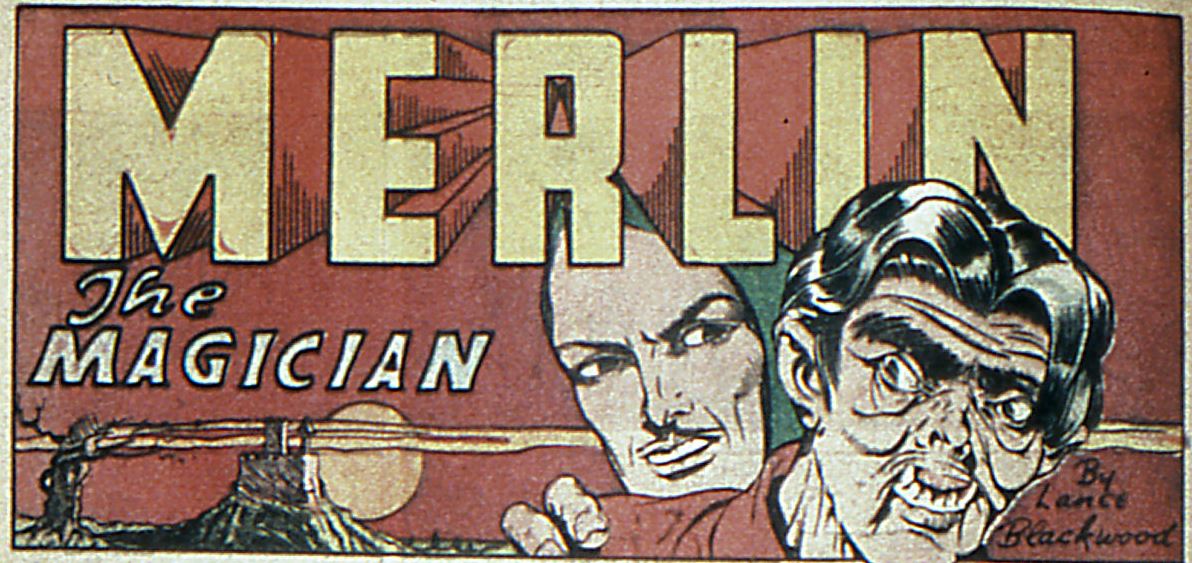
Jock Kellog, a wealthy playboy in the classic mold, spends the last of his family fortune on the same day he is summoned to the bedside of his sole relative, an unnamed uncle. Instead of the fat stacks of cash that he is hoping for, Kellog comes away with a cloak and the knowledge that he is supposedly the last descendant of Merlin of Arthuriana fame.

It turns out that he is in fact the last descendant of Merlin, of course, and that the cloak is a source of unlimited magical power in the grand tradition of mystic super-heroes like Zatara. Lucky for the world at large, the application of vast power has the opposite of its usual effect on the young wastrel and Jock devotes his newfound power to the defense and betterment of humanity. (National Comics 001, 1940)

MINOR SUPER-VILLAIN 992: THE VAHINES

(Jungle Comics 013, 1941) The Vahines, aka the Tiger-Women of Wildmoon Mountain, have a plan: kill every other woman in the world, which wil...