Showing posts with label Detective Comics. Show all posts

Tuesday, March 28, 2023

GENERIC COSTUMED VILLAIN ROUND-UP 004

They're back! They're costumed! They're generic!

Shorty Jones/ Generic Mummy

It's a sad day for me but I fear I have to classify this fake mummy as a generic costumed villain, even though he has a shortsword, one of the top swords. Ultimately, he's just a thief named Shorty Jones who robs the museum every night and even with the power of the fake mummy on his side Shorty just isn't interesting enough to qualify as a minor super-villain. (Detective Comics v1 053, 1941)

Gritter

Doc Savage battled this guy (real name the pretty good Gritter; posing as the amazingly-named Captain Blackstone Toy) who had a very complicated plan to blackmail the US Armed Forces. Also his chief henchman was named Fuzzy. (Doc Savage Comics 004, 1941)

Deputy Cal

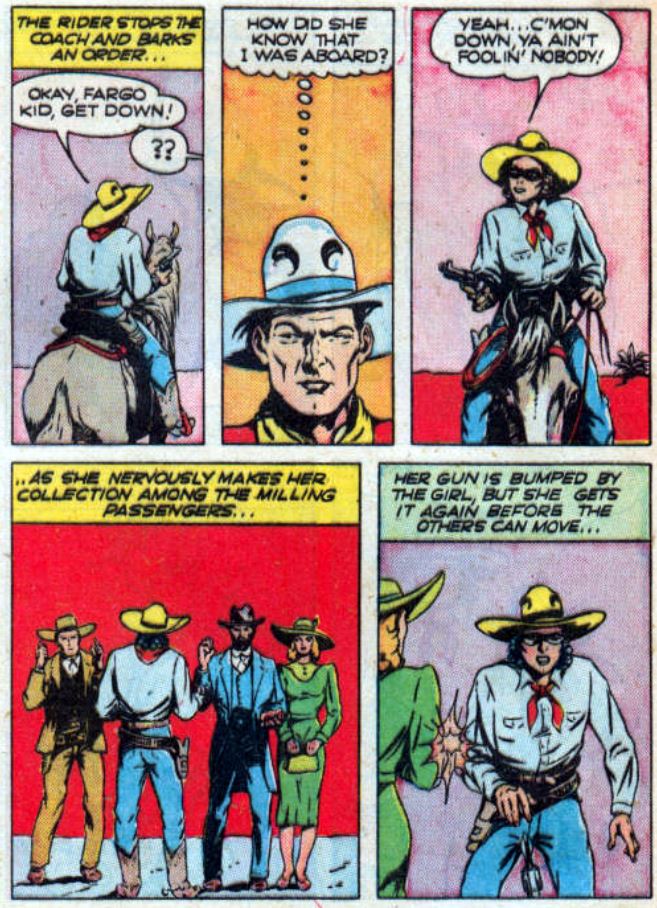
This lady bandit is in fact Deputy Cal of the Twin Forks Sheriff's office. His idea to crossdress as a major part of his holdup persona totally pays off, but unfortunately for him he completely fails to disguise himself in any other way - same distinctive horse, same clothes, a very confrontational attitude to anyone looking into the holdups rather than keeping his head down - and he swiftly gets run in by the Fargo Kid. (Feature Comics 048, 1941)

Unnamed Killer

This unnamed stablehand is that most banal of killers, a jilted suitor going after the romantic rival. But he goes to such effort! It takes two tries - with a remote-controlled sailboat and a sniper rfle - to get the guy, at which point the Red Bee impersonates him and is attacked with battleaxe, scythe, pitchfork and trap door.

Plus he dresses up as Death for one attempt! Truly this man was as close to non-generic as it's possible to be while still being completely forgettable. (Hit Comics 014, 1941) 

Saturday, December 3, 2022

NOTES: DECEMBER 2022

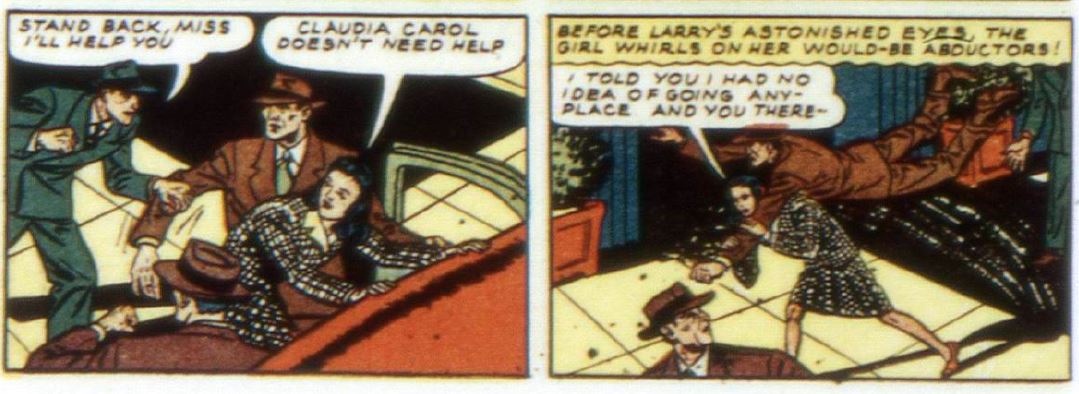
(Detective Comics v1 058, 1941)


Comic book character of the year Claudia Carol, folks.

Names: (Doc Savage Comics v1 003, 1941)

Bit of nominative determinism going on. The protagonist of this piece is Brad Marshall:


Marshal Brad Marshall:


Crook name of Bat Crawley (Feature Comics 040, 1941)


I'm only mostly certain, but I think that "Fasdick" here might be subbing in for "fascist". The government in question does bear all the hallmarks of being a stand-in for one of the Axis powers, but it's a wild stretch, even so. (Feature Comics 040, 1941)

SUPER-VILLAIN YEARBOOK: THE PENGUIN 1941

What was the Penguin up to in 1941?

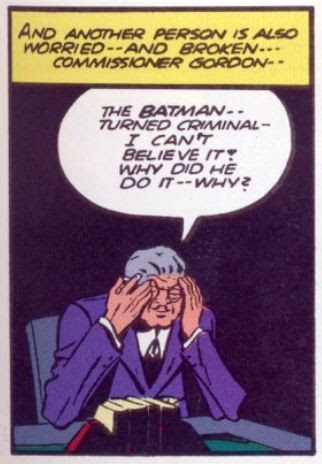
(Detective Comics v1 058) 'Untitled' **First Appearance**

Heeeey, it's the Penguin, the perennial second-tier Batman villain!


The Penguin really hits the ground running: he's already got his look and his suite of trick umbrellas, so all he really needs is his weird bird-obsession, which kicks in in 1942. 


As is frequently the case with a recurring villain, the Penguin's first outing is one of his most successful: he takes over a gang using his gift for planning crimes and then when Batman starts to butt in he frames him but good.


To really stick the landing, Penguin's men kidnap Batman while he's being transported to jail - Gotham's finest are convinced that he is a crook! The Penguin is getting ready to bump him off! 


Too bad for the Penguin that Robin shows up and the whole plan comes crashing down. Too bad for Batman and Robin that the Penguin actually manages to get away. The next story picks up where this one left off but that's in 1942 so I'll be telling you about it in like six months.

BODY COUNT: 2

END-OF-YEAR STATUS: At large.

Wednesday, November 30, 2022

MINOR SUPER-VILLAIN 219: THE FENCER

(Detective Comics v1 057, 1941)


A simple concept but a good one: the Fencer is the head of a vaguely-Axis espionage group that has been trying to kill anti-fascist author Jules Vortez for the past two issues using methods including causing plane crashes while still on the plane, duplicates, hypnosis and, sadly, blackface. Aside from the latter, this is exactly the sort of over-the-top behavior that should be going on all the time in a super-hero universe, so it's only appropriate when the leader appears in costume, declares himself the "greatest fencer the world has ever known" and initiates a duel to the death with US secret agent Bart Regan.

Unfortunately for the Fencer, though he ends up skewering Regan he doesn't do a good enough job to finish him off and their duel soon resumes as a good old American punching competition, one which the Fencer loses. Still, a good show while it lasted!

MINOR SUPER-VILLAIN 218: THE LIGHTNING KILLER

(Detective Comics v1 056, 1941)


The Lightning Killer is a neat and potentially great concept that was ill-served by being featured in a 6-page middle-of-the-book strip like Cliff Crosby's. As presented, he's a mysterious killer who strikes only during thunderstorms and times his shots to lightning strikes so that they go unnoticed by witnesses. Unsurprisingly, he turns out to be the meteorologist Cliff consults midway through the story, as he is the only non-cop/ non-victim/ non-protagonist character featured.

The Lightning Killer concept is cool enough that it deserves more! BRING him BACK, I say. Have the Lightning Murders play out over a year or two in the background of an ongoing, with thunderstorms being infrequent enough that he flies just under the radar but still leave an entire city on-edge! Or a recent murder could open up an investigation that reveals decades of seemingly unconnected slayings are the work of just one man! Neat stuff!

Tuesday, November 29, 2022

MINOR SUPER-VILLAIN 217: THE STONE IDOL

(Detective Comics v1 056, 1941)


The Stone Idol is a bit of a weird one: a miner living in the ghost town of Ghost Gulch City discovers silver on town land and recruits an unscrupulous group of circus performers to aid him in driving out the town's remaining inhabitants so as to have all the silver for themselves. The actual Stone Idol is the circus strongman disguised as a local Native American statue in order to play on the local superstitions but really it's a group effort.

Sadly for Mad Mack the prospector and his circus of crime, the Stone Idol's push to take over the town coincides with Bruce Wayne and Dick Grayson's stay in a local hotel and the entire group of them die in a mine collapse while fighting Batman and Robin. Perils of living in a comic book world, I guess.

Monday, November 28, 2022

MINOR SUPER-VILLAIN 216: DR DEKER

(Detective Comics v1 055, 1941)


Dr Deker is a spy chief and a fifth columnist from the heady days before the US entered WWI, so of course he's from an unnamed Fatherland and no further clarification is needed. He has the not-uncommon plan to kidnap prominent American scientists and steal their secrets, abetted by his very first acquisition: the Truth Machine, a device which unsurprisingly forces one to truthfully answer all questions.

All of this is pretty comics-regular and poor ol' Dr Deker would be consigned to the pile of discarded also-rans if not for two things: 1. the face that he is pulling in the third panel above and 2. the plan that he is detailing while making that face. Surely it is the mark of a true super-villain that when a method for causing insanity at range falls into his hands Deker's sole thought is to use it on his own men, that installing an entire factory worth of fifth columnists and then rendering them into violent madmen would be a more desirable end than simply having complete control over a factory in the first place. 

If you have the means to drive men insane then what other course is available? None, says Dr Deker, and that's why he's our Minor Super-Villain 216.

Sunday, November 27, 2022

GENERIC COSTUMED VILLAIN ROUND-UP 003

Yet another collection of also-rans and never-weres.

Philip White

Philip White here got exactly one panel into his career as a masked spy chief before Madam Fatal unmasked him. (Crack Comics 014, 1941)

Basil

An auctioneer named Basil ran an overly complicated scheme to steal the fabled Five Bloodstones of Mu. His plans were also undone by Madam Fatal and ended in his grisly demise. (Crack Comics 016, 1941)

Unnamed Crook

This unnamed thief almost got away with the Dare Diamond under the very nose of detective Larry Steele. (Detective Comics v1 049, 1941)

Howard

A baseball pitcher named Howard got up to some shady betting schemes and ended up a generic costumed villain. Let this be a lesson, kids. Also part of his big plan involved shooting himself in the arm with a gimmicked up baseball mitt-gun, which is an early sign that you might not be cut out for costumed villainy. (Detective Comics v1 052, 1941)

Saturday, November 26, 2022

MINOR SUPER-VILLAIN 215: THE THREE DEVILS

(Detective Comics v1 050, 1941) 


The Three Devils are an early example of a fairly common minor super-villain archetype: the acrobat who turns their skill to criminal ends (and of course this is a subset of "circus folk who use their talents for crime" which itself is a subset of "talented professional turns their talent to crime" and then I guess above that is "criminals"). 

I don't think I'm going to bother calling it out every time it happens but they also appear in an early example of what will eventually be a staple of Batman story structure through the 60s, told in three acts:

Act I: the villain's novel methods allow them to triumph over Batman and Robin and get away with their goal - a lot of stories following this structure take place after the Comics Code, so usually this is a theft of some kind.

Act II: Batman and Robin foil the villain's scheme but they still get away.

Act III: the villain is captured while attempting to achieve their goal.

In this case, the Three Devils are flung to their deaths from a clock tower rather than being captured but like I said, it's an early iteration of the format. It's also a format that I noticed while reading Silver Age Batman stories, so it'll be interesting to take note of how it develops and how much it is reflected in other super-hero comics of the time.

The other interesting thing about the Three Devils is that despite falling to their deaths in 1941 they return in Batman Comics v1 107 in 1957 as the Daredevils:


Now, I learned about this Three Devils/Daredevils connection on a fan wiki and so approached it with some skepticism but damned if they weren't right about this one:


They even use the same fence!

Now 1957 is a tricky year - Barry Allen had just debuted as the Flash; Martian Manhunter is running around... this could just be an Earth-One retelling of the Three Devils story, scrubbed of some supernatural cruft. Or these could be the same characters, not actually dead after all - this is the kind of thing that inspired nerds to come up with stuff like Earth-Two-A and Earth-B and so forth.

Friday, November 25, 2022

MINOR SUPER-VILLAIN 214: THE TERROR

(Detective Comics v1 049, 1941)


This is one of your technical qualifications: a singer's former partner, jealous of his success, comes back for revenge. He calls himself the Terror and has a camera-gun and a bunch of hired goons with names like Smokey Joe. It all adds up to just enough to land him in the theoretical super-villain wing of the prison when Slam Bradley busts him.

Thursday, November 24, 2022

MINOR SUPER-VILLAIN 212: ECHO

(Detective Comics v1 049, 1941)


The story elements of this aren't anything special: a mad scientist builds a giant robot (or something) and sends it to get revenge on the world what shunned him for his wild ideas about building giant robots (or something). Eventually he gets sloppy and the Crimson Avenger tracks him back to his lair and in a twist of mild irony the order that was meant to cause the ultra-literal Echo to kill the Crimson instead results in the death of the scientist.

Echo is a perfectly fine example of the giant robot but the only really interesting part of this whole story is that it's a bit ambiguous what exactly he is? Like he's probably a robot, but read this:


"A horrible experiment," "a man-made giant." He could be a frankenstein, or a weird clone beast or a cybernetic humanoid toadstool! He's almost certainly supposed to be a robot, but the mind boggles at the possibilities! If only the Crimson Avenger hadn't tossed him off a cliff!

Wednesday, November 23, 2022

SUPER-VILLAIN YEARBOOK: CLAYFACE 1941

Detective Comics v1 049, 'Clayface Walks Again!'


Clayface's 1941 adventure starts with two asylum guards learning a very important lesson a bit too late: if you exist in a fictional setting, never transport a homicidal maniac in a storm. It's as true in a 1941 comic book as it was in any of the Halloween movies.

Sadly, they remain unaware of the laws of narrative causality right un until their demise while Basil "Clayface" Karlo, protected by those same laws, escapes into the night to kill a man for theatrical makeup.


We are finally treated to a clear look at the Clayface mask and it's appropriately horrible.

Since it's his second outing, there's no need for the mystery element of the story, which ends up making this a far less bloody yarn than the last one: Clayface sets out to burn down his former movie studio but since this is a very predictable thing for him to do he is interrupted by Batman and Robin. He does almost manage to kill the two of them, but they get out of it as you might have guessed.


From here on Clayface focusses his efforts on Julie Madison, as-of-this-issue former fiancé of Bruce Wayne and newly famous actress rebranded as "Portia Storme" to fulfil the whims of 1940s Hollywood. It's never spelled out so his motivation is equally likely to be that she escaped him on his last murder spree as it is that her death would prove most harmful to the studio. 

Has any wag made much of Bruce Wayne's fiance being exactly the same size as Robin? It seems like the sort of thing they would go on about.

Clayface is eventually reapprehended after a complicated slight-of hand trick that substitutes Robin for Portia and relies on him using only piercing weapons to the torso. It pays off, so who am I to quibble or suggest that Portia simply wear the life preserver from the start?

That's it for Clayface for about thirty years!

Number of Episodes of the "Super-Villains of Hollywood" podcast: Just one episode for 1941, I'm afraid. It's an eventful time but not enough to sustain more than an hour and half of podcasting.

Body Count: 1

End-of-year Status: Captured

Tuesday, November 22, 2022

SUPER-VILLAIN YEARBOOK: THE JOKER 1940

What did the Joker get up to in 1940?

1. Batman Comics v1 001, 'Untitled' **first appearance**


The Joker really hits the ground running in his first crime-outing. He establishes his character - prideful, mercurial and on-theme - and methods that are still in his repertoire to this day


He indulges in the old standard of warning the police ahead of time, then killing his target and stealing their named gems (uh, this is a personal term for any gem famous enough to have a name, like the Hope Diamond. they make more frequent appearances in comics than real life, unsurprisingly). Not the most creative of crime sprees by his own eventual standard, but everyone has to start somewhere. He also murders a number of people who challenge him, including a gang boss and a judge who once sent him to jail (a perfect 1/1 judge and jury revenge slaying! Aim low, kids!).


Also established this adventure: the smiling-death style of Joker Venom, as well as:


...the classic hideous Joker calling card design.

But despite racking up an impressive success rate and almost killing both Batman and Robin on several occasions, the Joker ends his first outing in the slammer.

2. Batman Comics v1 001, 'The Joker Returns'

That's right, the Joker makes his second appearance in the same issue as his first! They knew he was a hot property from the very start!


After a very dramatic escape from prison and a relocation to his secret cemetery hideout, the Joker settles into his familiar pattern: a taunting message, then theft or the murder of his enemies. In achieving the latter, he employs two of my very favourite deathtraps in comics:


To bump off the Chief of Police: a sound-activated poison dart launcher concealed in his telephone - and he activates it by shouting his own name real loud! Tremendous style points there.


The second is just sharpened playing cars with poison on the edges, but again there's some tremendous style on display in the commitment to the bit of having an entire pack of jokers. Completely worth going around to every gaming supply store in Gotham to buy packs of the same brand of cards.


A minor point in this adventure is that it highlights that the Joker is primarily a jewel thief, something that I associate with the Golden Age version of the character but that might just be me extrapolating from this issue.


And finally we have the death of the Joker, truly one of the great on-brand death scenes of all time as he gets stabbed while struggling over a knife with Batman. It was a good run but the Joker is dead.


OR IS HE???

3. Batman Comics v1 002, 'Untitled'


Since the Joker actually survived the last issue, both Batman and the members of Crime Syndicate Inc  have the same idea: kidnap him while he's being treated for his injuries, the former for some sort of gruesome lobotomy and the latter as a replacement for their recently deceased leader. More than half of the story is taken up with the dueling Joker kidnappings, after which he predictably betrays the crooks, strikes out on his own and ends up left for dead in a burning castle.

More interesting to me is that this is the end of a sequence of events that, well, here's a timeline:

-Initial Joker crime spree. No time period is specified in the story but it seems a fairly rapid-fire series of crimes. Somewhere between 1 and 2 weeks, we'll say. Joker is captured.

-Two days later, Joker escapes. His crime spree resumes at the same pace, with at least two robberies occurring sequentially. Say another 1 to 2 weeks. Joker is seriously injured and rushed to hospital.

-Crooks spirit Joker away following his treatment. His recovery lasts one week, after which he seemingly dies in a fire.

What this all adds up to is a situation like Friday the Thirteenth 2 through 4, but whereas that was an astonishingly bloody weekend told over the course of three movies, this is the Joker committing at least 6 high-profile robberies and 13 murders over the course of one to two months! A huge debut for the big guy!

4. Detective Comics v1 045, 'The Case of the Laughing Death'

Predictably, the Joker is not, in fact, dead! He remains alive to this day if you can believe it!


He has, though, adopted a brand new modus operandi. Perhaps drawing on his brief time with Crime Syndicate Inc, he slips for the first time into an alter ego with the infuriating surname of Rekoj and forms a little gang of his own. Then, after his gang pulls a heist, he robs them as the Joker so that he doesn't have to split the profits with them. IT'S A DUMB PLAN BUT IT WORKS.


I'm willing to forgive, but only because of the great deathtraps, and this is a fun one: a record that releases Joker Toxin as it plays, thus killing even as its message is delivered. Insidious!


At story's end, the Joker is in the drink, presumed dead. For good? No.

5. Batman Comics v1 004, 'The Case of the Joker's Crime Circus!'


For his final outing of 1940, the Joker assembles another gang. This time, it's one of my favourite styles of gang, the circus of crime! They specialize in casing wealthy patrons' estates and manors and then using their circus skills to rob the various joints.


Batman being Batman, he pieces together the clues and tracks down the Joker, who ends the adventure in the traditional manner by seemingly plummeting to his death.

Body Count: at least 14

End-of-year Status: Presumed Dead

MINOR SUPER-VILLAIN 992: THE VAHINES

(Jungle Comics 013, 1941) The Vahines, aka the Tiger-Women of Wildmoon Mountain, have a plan: kill every other woman in the world, which wil...