Showing posts with label Face. Show all posts

Saturday, May 16, 2026

MEDIA IN COMICS 003

We've hit a rich seam of comic book movies this time, by Jove.

Movies:


Eaglets of America is a film about flying cadets, filmed at the same field that aspiring pilot Lucky Byrd trains at. There is some unpleasantness with a lecherous leading man, alas, but it all gets sorted by the end. (Target Comics v1 002, 1940)


The 1933 film the Prizefighter and the Lady, starring boxer Max Baer opposite Myrna Loy, was a real touchstone back during the heyday of boxing comics. Given enough appearances, and boxer would end up in Hollywood in a sports romance with a variably terrible name. Hot Fists and Hot Lips, starring Kayo Ward, might just have the worst title of them all. (Pep Comics 008, 1940)


Much like all those times that two volcano movies or two asteroid movies come out in quick succession, Miracle Movies and Bee Pictures are each working on a "lion picture" at the same time, only while Leo, King of Beasts makes it to theatres o sink or swim on its own merit, Jungle King is never completed due to the fact that its producer resorts to murder to get his movie out first. (Fight Comics 007, 1940)


There's no romance plot (on-panel, at least), but Pardon My Glove starring Kayo Kirby is absolutely another riff on The Prizefighter and the Lady. (Fight Comics 004, 1940)


The Mad Martian may not get anything approaching a plot synopsis, but it has the distinction of being the inspiration for villain Red Dugan to commission the creation of a monstrous minion. (Blue Ribbon Comics 003, 1940)


Though it was announced as being the subject of the next instalment of actress Diana Deane's comic, War Nurse never actually appeared due to the strip being cancelled. A shame as I was really curious about the amount of dripping blood and what that might presage. (Funny Pages v1 004, 1940) 


Like long-running comic strip Minute Movies, the concept of 'Fantastic Feature Films' is that of a series of movies acted by a recurring stable of actors. It's a very fun idea that only lasts a double handful of issues, alas.

The plot of Dance of Death involves a plot to assassinate a Hitler analog using an exotic dancer's prop bubble that has been filled with gas. Interestingly, the plot is less concerned with making sure that the plot succeeds than it is with trying to foil it so that the dancer doesn't get into trouble. (Target Comics v1 003, 1940)


Devil's Dust concerns an outcast Frenchman whose harsh treatment has made him a misanthrope and who only turns his supply of metal-dissolving dust to the cause of world peace after a gregarious American calls him "pal." (Target Comics v1 002, 1940)


The Maskless Axeman is a very strange film about a tuxedo-clad executioner who works for a Hitler analog and who driven mad by a fake haunting in order to save the life of a dancer accused of spying. (Target Comics v1 001, 1940)

Radio:


I like a good DJ name, and I appreciate just how tired "Stay-Up Dan, the All-Night Music Man" looks. (The Face 001, 1941)

Thursday, May 14, 2026

DIVINE ROUND-UP 029

Comic book religion. Tricky stuff.

Hercules

The thing that really jumps out at you when you first encounter this version of Hercules is that he goes to Valhalla when he dies, which is weird. The second thing is that he is appearing in a Golden Age Marvel comic and so there might be fun storytelling ramifications considering the fact that Hercules is a moderately popular (and alive) Marvel Comics character with appearances from the mid-60s to today. Perhaps the fact that this is a pretty Roman mythology (aside from the Valhalla thing) and Hercules from  the Champions is from a Greek one can play into it.

The third thing that jumps out at you comes on maybe your third reading of the comic in question, when you pay a bit more attention to that first panel in which Hercules is dying and realize that he is not only meant to have survived until some time after the founding of the United States but that the heavy shadowing on the faces of the people in that panel kind of implies that he might have been one of the Founding Fathers? There just aren't enough clues in the art to tell for sure but I know Simon and Kirby's tricks and making George Washington Hercules is just their style.


After spending a while in Valhalla, Herc gets worried about the rise of fascism and decides to reincarnate as a mortal in order to be there to lend a hand when the US needs him (a real snub to his former fave of Rome) so he heads on back to be reborn as Marvel Boy

God Style: Real (Daring Mystery Comics 006, 1940)

Jupiter:


Like his son Hercules, this version of Jupiter is very concerned with personal freedom and the fate of the United States in particular. Or maybe he's just a good father who wants to support his son's little projects.


Whatever the reason, he shows up on his reincarnated son's fifteenth birthday to deliver a cool super-hero uniform before making a very cool exit via lightning storm. 

God Style: Real (Daring Mystery Comics 006, 1940)

Father Patriot:


Father Patriot is the brand-new anthropomorphic personification of the spirit of America created by an unknown comics scribe for the origin story of Major Victory. As I have already speculated behind that link, my only real guess as to why they might have done this is to avoid stepping on Quality Comics' toes by using Uncle Sam for the role. I was going to complain about them not replacing him with one the less-used personifications of America like Brother Jonathan or Columbia, but on reflection I can see why they might have wanted to go with an all-new character. If nothing else, this means that they had free reign to add as much patriotic nonsense to his design as they wanted to, like his retinue of patriotic angels or the fact that he can whale on the Liberty Bell to impart strength unto his champion. They also got to design a set of patriotic clothing for him, and while it doesn't quite match up to the classic Uncle Sam look I do appreciate his big gaudy belt buckle.

Speaking of those mysterious angelic servants: does this indicate that the glories of to American Heaven are not exclusive to the mythology of Captain Fearless?

God Style: Real (Anthropomorphic Personification) (Dynamic Comics 001, 1941)

Maloo:


No non-white and non-monotheistic group is immune to the threat of Golden Age comics just making up some random god that they supposedly worship, and the Aboriginal Australians are no exception. Maloo is a giant, vicious kangaroo who the Face is nearly sacrificed to but who ends up dead instead. Sorry, Maloo. Sorry, Aboriginal Australians.

God Style: Animist (The Face 001, 1941) 

Tuesday, March 24, 2026

CATALOGUE OF WOUNDS 007

The right shoulder: unsung victim of the comics pages. 

Captain Battle


Captain Battle gets a fashionable bullet-creased skull on the docks of San Francisco. (Captain Battle Comics 001, 1941) 

the Cloak:


Being shot in the left shoulder is the inciting incident that leads Jeff Cardiff to adopt the Cloak identity in the first place. (Big Shot Comics 015, 1941)

the Face:


Shot in the right shoulder (Big Shot Comics 011, 1941)


Shot in the right shoulder again. (Big Shot Comics 018, 1941)


Shot in the left shoulder, which must have come as a relief. (Big Shot Comics 019, 1941)

the Fox:


Shot in the right shoulder. (Blue Ribbon Comics 012, 1941)

Kaänga

Shot in the right shoulder. (Jungle Comics 003, 1940)

Marvelo, Monarch of Magicians:


Shot in the right arm. (Big Shot Comics 012, 1941)


In what is probably the most sever non-fatal injury we have seen thus far, Marvelo takes an ape-powered throwing knife to the chest and is just barely alive for the remainder of the comic. (Big Shot Comics 016, 1941)

Skyman:

Skyman is shot in the ever-popular right shoulder, and no wonder: it's a big ol' target. (Big Shot Comics 002, 1940)

Sunday, April 14, 2024

MINOR SUPER-VILLAIN 496: THE CHIEF AND THE COBRA

(Big Shot Comics 016, 1941)


The Cobra technically works for the Chief if you want to exclusively go by the criminal org chart, but the Cobra is also the only reason for the Chief being mentioned at all and not just thrown into my big bin of nondescript gang bosses. Thus: a dual entry.

Like I said, the Chief is your regular degular gang boss, albeit one who swans around in a green smoking jacket the whole time. Feeling the pinch as the Face cracks down on crime, he hires the Cobra, a rare super-powered Columbia Comics Corporation character. It's not much - she can do comic book hypnotism that causes her target to see what she wants and also scry her hypnotized target using a crystal ball - but it's more than most of her criminal peers have.

The Chief and the Cobra essentially prank the Face's secret identity Tony Trent by making him think that a man and then an entire house have disappeared, with the idea being that Trent, who at this point "knows" the Face in the same way Clark Kent knows Superman, will bring him in to investigate. And it works, only instead of being easily killed the Face does his regular schtick and beats everyone up. It's your classic villain's 2/3 of a plan - no consideration for how to deal with their foe, only how to draw them out.

The Chief and the Cobra are pretty swiftly rounded up. Is hypnotizing a guy not to see a house and then looking at him in a crystal ball a crime? If not I assume that the Cobra was released pretty swiftly. I mean, she did try to shoot the Face at the end of the story but good luck ever convicting someone of attempted murder of a masked vigilante, amiright?

Sunday, April 7, 2024

MINOR SUPER-VILLAIN 490: THE HOOK

(Big Shot Comics 003, 1940)

Is a hook hand the most basic gimmick that automatically flips a gang boss over to being a super-villain in my mind? We don't have enough data to call it yet but all signs point to Probably. 

This Hook is Hook Horner and there's not too much to say about him: he kidnaps a young woman sometime between the death of someone she is set to inherit millions from but before she herself knows about it, ie, while the money is still going to be in legal limbo for a while yet, ie, way too early. He gives the Face a run for his money but like a lot of hook-handed villains in the end he dies because his hook gets caught on something, in this case a speeding car.

Saturday, April 6, 2024

MINOR SUPER-VILLAIN 489: THE GOLDMASTER

(Big Shot Comics 002, 1940) 

The Goldmaster is one of my very favourite subtypes of super-villain: the guy who really leans into the bit. Specifically, he is a fellow who has discovered the secret of making gold and subsequently adopted all of the trappings of a Medieval alchemist. Or possibly he was a guy who was really into the alchemy lifestyle who made the luckiest find ever. Either way, he doesn't have to live like this! It's a choice!

No matter what the Goldmaster's route to infinite gold production was, he certainly has all the fighting skills of a quicksilver-raddled mystic. He and his gang of would-be economic titans are gathered up with very little effort by the Face, with the Goldmaster himself ultimately choosing the coward's way out.

Friday, April 5, 2024

MINOR SUPER-HERO ROUND-UP 005

All Columbia Comic Corporation edition!

Skyman

Skyman (properly the Skyman but it just doesn't scan for me) is a pilot hero, normally a ho-hum sort of character for me. But between his sci-fi super plane (the Wing), his blood-freezing stun ray (the Stasimatic) and his cool on-the-edge-of-being-too-busy costume there's just enough super-hero peanut butter mixed in with the pilot chocolate to make it appealing (bonus running list of Skyman's super science: atomic explosives, invisible glass phonograph, disitegrator ray, explosives-detonating ray and a ray that fuses gun barrels shut)

After a few issues we learn that the Skyman is actually Allan Turner, wealthy good-for-nothing playboy who lost his parents to a plane crash when he was a child. If the Bruce Wayne parallel was 1:1 he would have grown up to become a noted slayer of planes, but that's a villain's origin. Instead, Allan Turner dresses up as a plane to fight criminals. It doesn't make quite as much narrative sense as Batman does but it's probably more fun to read than the other way around.

Early Skyman also might just hold the record for the most overinflated torso in comics outside of parody characters. He gets a bit more proportional eventually but for a while there you're concerned for his ability to live a normal life.

the Face:

The Face, like a lot of early comics heroes, draws a lot of elements from the pulps: a tuxedo-clad hero drives around in a souped up roadster fighting crime with his fists and an automatic - a pretty regular early super-guy. Even his secret identity of Tony Trent, radio station owner/ radio announcer is in the pulp-adjacent character wheelhouse.

It was very exciting to me when I realized that the Face's face is frequently referred to as a rubberoid mask, my favourite term for the kind of masks that only exist in comic books - perfectly realistic and naturalistic but also very easy to don and doff. This particular mask was made specially for Tony Trent by someone whose other major characteristic is being dead, which is apparently a combination that makes Trent feel quite jolly.

Weirdly, in Big Shot Comics 006, the Face has a new, slightly less grotesque mask. No word on where he got this one but he goes back to the original pretty quickly.

Marvelo, Monarch of Magicians:

Created by Fred Guardineer, who also created Zatara over at DC Comics, Marvelo is... extremely similar to Zatara. Aside from their different approaches to dressing like a stage magician, I'd say that there are two slight differences between the characters: 

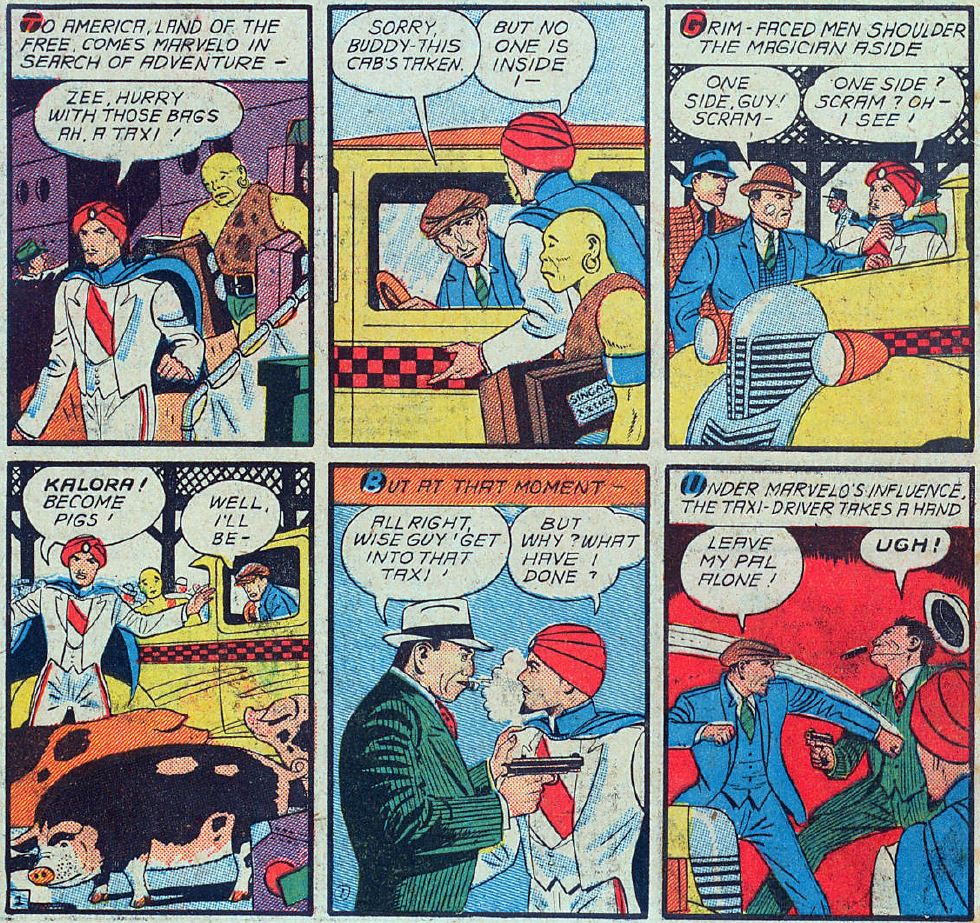
1. Rather than speaking backward to cast spells, Marvelo shouts "Kalora!" as an all-purpose magic word.

2. Marvelo's manservant Zee is just a hair more racist than Zatara's manservant Tong. It's pretty close but I reckon Zee takes it.

Big Shot Comics 017 reveals that Marvelo is the son of the ruler of the generically foreign South Pacific island of Brahama (hell on autocorrect). This doesn't seem to have anything to do with him being a magic man but it's nice to know. (Big Shot Comics 001, 1940)

the Cloak:

Jeff Cardiff, Spy Chief was a feature in Big Shot Comics from issue 1 (well, it was Jeff Cardiff, Spy-Master for the first issue or two but the point stands) with all kinds of foiled plots and plans and spies of both the vaguely fascist and vaguely communist varieties. In Issue 15, however, the spies adopt the reasonable policy of attempting to shoot on sight the man who has foiled so many of their plans and a wounded Jeff Cardiff goes to recuperate at his brother's house.

Long story short, Jed Cardiff is a coal magnate with a collection of "adventure curios", including the namesake cloak of Revolutionary War-era costumed spy the Cloak and it being 1941 and a comic book, Jeff immediately adopts the Cloak identity as his own. It's a fairly basic costumed hero shtick but I appreciate the effort and it's always nice to see a more elaborate cape and cowl getup now and then. (Big Shot Comics 015, 1941)

The original Cloak eventually shows up in a flashback and it turns out that his impact on the history of the American Revolution is only slightly less impactful than Superboy's in the 1949 story in which he goes back in time and takes part in about half the major events of the war. I must say that I do love a retcon of a historical event. (Big Shot Comics 021, 1942)

FASCIST GOON CLEARING HOUSE 015

If there's one thing I know it's that the world has a seemingly-inexhaustible supply of odious little fascist worms. the All-America...