Showing posts with label cosmic ray mutate. Show all posts

Sunday, May 17, 2026

MINOR SUPER-VILLAIN 964: THE SHARK

(The Face 001, 1941)


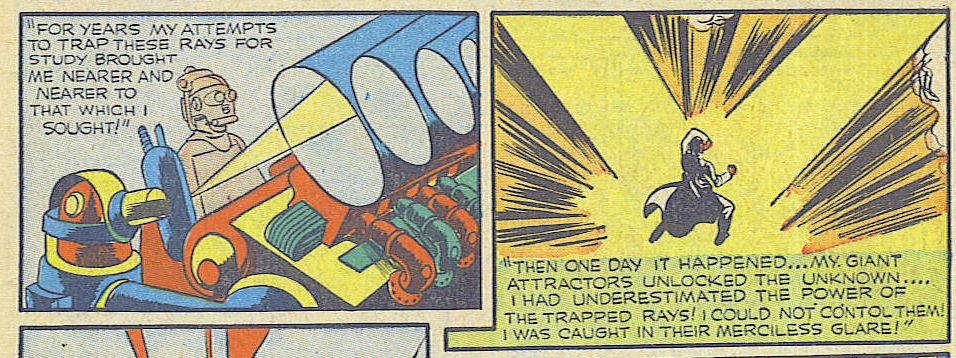
"Sparky Watts" was a long-running comic feature in Big Shot Comics and other Columbia publications about the eponymous Sparky Watts, a down-on-his-luck young man whose life turns around when scientist Doc Static gives him super powers using his cosmic ray machine. Having started out as a comic strip, Watts' adventures tend to hew closer to the comic adventurous rather than the super-heroic. Still, every once in a while he encounters a minor super-villain such as the Shark.


The Shark is a crypto-fascist in the truest sense: he clearly started out as a Nazi and his men bear some of the visual tropes of Nazi spies, but between the bizarre formality of his speech (which mimics the mock-Japanese speech patterns of 1940s comics while also being distinct from them) and the names of his underlings (Flitoog, Saber, Egnog, Kabitz) which approach mock-German without really getting there, it all ends up being the mere suggestion of a smear of an Axis pastiche.

The really important thing about the Shark is that he's a shark weirdo. He looks like a shark, he loves sharks, he has shark-themed decor and he bites people's throats out with his "shark-like teeth" or at least threatens to. It's always a joy to see a true oddball find his groove, even if it's as an evil fascist. But preferably not as an evil fascist.


The Shark and his men have heard of Sparky's remarkable strength and have set out to acquire it for themselves, and since Sparky isn't really in this issue (he's off playing baseball tow towns over) they don't have much trouble roughing up his friends to get what they want.


Doc Static, of course, neglects to tell them that absorbing an insufficient charge of cosmic rays means that the power is temporary, and that once the rays leave the human body it shrivels up and shrinks until it is smaller than a grain of sand. The fascists all turn on one another once they achieve any sort of power which occupies them until they shrivel, and then an over-zealous minion (who was not invited along to get super powers) seals the deal by crushing all of the "bugs." The world is safe!

Tuesday, March 25, 2025

MINOR SUPER-HERO ROUND-UP 042

Boys! Boys! Boys! Super powered boys!

Magno


Magno, aka the Miracle Man, aka the Magnetic Man, aka Tom Dalton, was a power line worker who died when he was shocked with 10 000 volts DC and then revived when he was shocked again with 10 000 volts AC. As a result, Dalton developed electromagnetic powers that he used to fly, simulate super strength when dealing with metal and create magnetic force fields. Not a bad deal.

Magno's Golden Age career was short and fairly undistinguished, and his main claim to fame is being the only one of the old Quality heroes to be killed off by Roy Thomas in All-Star Squadron to never be brought back (Magno's look also reminds me of Jericho of the Teen Titans for some reason, but that's hardly another claim to fame). (Smash Comics 013, 1940)

the Ray


I had a couple of issues of The Ray comics from the early 90s when I was younger and so have a tendency to think of the Ray as being a far more prominent character than he actually is - he's got to be fourth-tier at best, really (assuming that top-tier characters are the ones that everyone knows, your Batmans and Supermans, and second-tier are the ones that even a casual comics reader would consider essential. Third-tier and below is where you get into debating territory).

Regardless of his level of prominence, the Ray is actually Happy Terrill, a devil-may-care young reporter who signs on as crew in a balloon trip to the upper atmosphere and is... empowered? When he ventures out into a cosmic storm to secure some essential safety equipment. Honestly, as presented on the page Terrill could be assumed to have been replaced with some sort of cosmic entity but maybe I'm the only one who thinks that because it certainly isn't reflected in subsequent Ray lore.

Cosmic entity posing as human or no, the Ray is endowed with a startling array of powers, including at least partial invulnerability, the ability to become and travel along light, giant growth, a healing touch, light projection and telekinetic rays. At first, anyway - after a couple of issues he adopts more of a two-fisted adventurer persona whose main power is the ability to change between Happy Terrill and Ray identities and who occasionally remembers that he can fly and shoot rays of light at people.

A fairly consistent thing that I've noticed in depictions of the Ray post-Golden Age is a tendency to portray him as a very dour and serious guy, which seems a disservice to someone with the nickname "Happy." I suppose I must give it to those later scribes in that the Ray himself almost discards his Happy Terrill identity in his first adventure before eventually coming to his senses. Neither the reason for resuming life as Happy nor the process by which he explained how he made his way back from the upper atmosphere is shown on-panel, but I have to assume that being a super-hero 24/7 just gets boring after a while and he wanted to have a bit of a break. (Smash Comics 014, 1940)

Master Man


Master Man starts out as a weedy little kid, too small to play, who is gifted a magic vitamin pill by a kindly doctor and becomes incredibly powerful adult man. It's all there on his one-page introduction, but what's missing is one important detail: is this a gradual process like the Champ's origin, where he takes the vitamin every day and grows up big and strong, or did this little kid instantly transmogrify into a grown man, like a permanent Captain Marvel? I suppose that if Master Man really is a little kid in a man's body it would explain why his first act is to build a cool clubhouse on top of a mountain, presumably containing lots of slides and fireman poles instead of stairs. 

Being a Fawcett Comics character, Master Man is technically owned by DC Comics now, though they haven't yet bothered to trot him out of retirement, possibly because of his name, which sounds fascist enough that Marvel Comics has several full-fledged Nazi characters that use it. He would be an interesting character to use as a foil for Superman, since his powers are magic-based, but Captain Marvel does usually fill that role so we're unlikely to get a Master Man revival any time soon. (Master Comics 001, 1940)

El Carim:

One more crime-fighting-stage-magician-with-actual-magical-powers for the pile, El Carim ("miracle" backwards, as the caption box is at some pains to inform you at the start of every story) also subscribes to the same tuxedo and thin black mustache school of fashion as his contemporary Zatara, though the turban does make it easy to tell the two apart.


What sets El Carim apart from his contemporaries early on is the fact that his crime fighting is done with a series of magical items rather than with magical spells. He has a magical monocle that can deflect bullets (in what must be a very alarming manner, visually) and project illusions and which can be combined with a device called the Spectograph to scry distant locations. In addition, he has a super powerful magnet capable of plucking bullets from the air (useful for when he already has a headache from bouncing a few off of his eye, perhaps) and the Arrestor, which is able to freeze others in place, even against the pull of gravity.

Over time, El Carim starts slinging spells in a way more in line with the other magic men of comics, and I personally reckon that that's why he has languished in relative obscurity since the 1940s (other than an appearance in a 2016 issue of Scooby-Doo Team-Up, that is), as without that hook he is not appreciably different from any of his peers. (Master Comics 001, 1940)

Monday, January 6, 2025

MINOR SUPER-HERO ROUND-UP 034

Here they are! Some guys you've never heard of!

the Press Guardian

In the Press Guardian's first outing he is known as the Falcon, but he has the same core mission as he will throughout his career: to clean up crime in Central City via the free press, even if he must do so in a pretty bad costume. A fair few places online list reporter Flash Calvert as the Falcon's secret identity but this is one of your classic reading comprehension/ research tests: it certainly seems like Calvert is the Falcon right up to the last third of the story, in which they start appearing in the same panels as one another. Thus, a claim that Calvert is the Falcon means that the claimant either skimmed the story in question or is taking the word of another who did so.

By Pep Comics 002, the Falcon has officially changed his name to the Press Guardian and traded in his Victorian daredevil costume for a classic suit-and-mask combo. His identity is also revealed as Perry Chase, society columnist and universally derided failson of the publisher of the Daily Express. As with a lot of Golden Age heroes the necessity for your secret identity to be the subject of scorn is not really explained - surely the same effect could be achieved by faking a limp or something and then people wouldn't constantly be insulting you to your face.

But the papes must go through, and the majority of the Press Guardians adventures have a hand in ensuring that they do, if only tangentially. (Pep Comics 001, 1940)

Auro, Lord of Jupiter:

Before Auro was lord of anything he was just some kid with the last name Hardwich who was out on a Sunday space drive with his family when all of a sudden things went wrong and the family space car crashed into the solid, non-gaseous, habitable surface of the planet Jupiter. There, the now-orphaned boy is raised by a Jovian tiger, becomes extra beefy in the high gravity environment, and rises to a position of leadership in the nearby tribe of "Jupiter Brutes," who name him Auro, meaning "Unconquerable".

All this is pretty standard jungle orphan, white guy exceptionalism stuff and I'm sure that one could make a pretty good case for it being just as unpleasant a series of tropes even when divorced from any real-world peoples etc, but what I must focus on is the fact that when you put a jungle guy in space he becomes a space barbarian and is actually pretty entertaining to read. (Planet Comics 001, 1940)

the Red Comet:

Speaking of taking character tropes from one comic genre and putting them in another, here's the Red Comet! Like his fellow Fiction House hero the Red Panther, the Red Comet brings super-hero style to a non-super-heroic world, or worlds in this case, as he beetles around the cosmos righting wrongs.

The Red Comet's main trick involves shrinking and growing at will, but over time he demonstrates a wide range of situationally useful abilities including but not limited to: a crime-in-progress sense, insect communication, invisibility, super strength, the ability to survive in space without PPE, flight and the ability to change the size of others.


The Red Comet's ability to change size is initially attributed to advanced technology (an "intra-atomic space adjuster," natch), while his expanded ability set is generally described as "magic." Then, in Planet Comics 009, he is on a dinner date and explains that he got his size control abilities when he was struck by "some outer space force," which gives him a more traditional super-hero origin. No word on whether his ability to talk to termites is still magic or as a result of another jolt of cosmic energy. (Planet Comics 001, 1940)

Tiger Hart of Crossbone Castle:

Tiger Hart is one of the more obscure Fletcher Hanks characters, a medieval warrior who spends his sole recorded adventure seeking the Great Solinoor Diamond (time for a Real Folk entry for the Koh-i-noor, I suppose) in order to free Queen Hilda from the clutches of the bandit chieftain Turk-the-Terrible. 

All pretty standard sword and sorcery stuff but, presumably in deference to the fact that the story was being published in Planet Comics, it all takes place on the planet Saturn. This raises many questions! Are Tiger Hart et al Saturnians? Are they from a far enough future that humans have colonized Saturn (and the habitability of Saturn must be taken as a given, alas) and then gone through a societal collapse of some kind, a Dark Age and now a medieval-style era? Or, as the only real reference to Saturn is that the Solinoor is from Saturn, is the story set on a far-future retromedieval Earth? Many things to ponder. (Planet Comics 002, 1940)

Saturday, April 27, 2024

MINOR SUPER-VILLAIN 505: MARTO

(Blue Bolt v1 006, 1940) 

Blue Bolt is a fine comic book character in the classic setting of a vast underground world full of sci-fi/fantasy concepts but 100% the best thing about him is that 10 or so of his first dozen appearances were by Jack Kirby and Joe Simon and boy does Marto here show it. Just look at this classic Kirby creation!


Marto was originally Martin Hall, a scientist who accidentally bombarded himself with the very cosmic rays he had been studying and found himself mutated into your prototypical future human: big brain, tiny shrivelled body and compulsion to change his name to something short that sounds like an Australian gave him a nickname. 

"Martin Hall" doesn't sound like a Voltoran name to me (they trend more to things like Count Gorth, Major Kadronin and Captain Drogar), so Marto presumably made his way to the Green Sorceress' underground kingdom from the surface in his little chair-bot.

Marto's initial offer is to help the Green Sorceress in her quest to conquer the underground world but he pretty swiftly reveals that he is a little incel creep and his real plan is to either stick his head on Blue Bolt's body or to merely transfer his mind into Blue Bolt's head. Either way, his next step is to mate with a mind-controlled Green Sorceress, create a super-race and subjugate the world (and the way that he says this makes it clear that he is racist against everyone). 100% creep, in other words.

Luckily for literally everyone, Marto failed to factor "armed resistance" into his plans and he is crushed by rubble during an attack by Doctor Bertoff's air force.

ALIENS AND SO FORTH ROUND-UP 040

Weird humanoids as far as the eye can see! Demon People :  The Demon People are seemingly native to the dimension that Breeze Barton trave...