Saturday, January 25, 2025

MINOR SUPER-VILLAIN 711: MAYTUS, KING OF THE BEASTS

(Prize Comics 005, 1940)

Late in his first incarnation, Power Nelson makes the acquaintance of Zora Doone, agent of the Interplanetary Red Cross, and the two form a very horny-but-chaste relationship. At her behest, Nelson takes a break from not freeing the people of Earth from the tyrannical rule of Seng I to investigate conditions on planet Ato, where humans are ruled... BY APES!


Yes, it's a good old fashioned Planet of the Apes situation on Ato. Humans are treated as animals, act as beast of burden, are fed on garbage, etc, while apes get to be cops and wagon-drivers. It just ain't fair!

There isn't really any exploration of why or how exactly the apes are in charge on Ato - the humans seem to be intelligent and verbal and the apes know it... Is this a race thing? It probably is, isn't it - whether the writer consciously wrote it that way or not it's got a lot in common with fantasies of white oppression under the heels of the "lesser" races (oh wait, I forgot that this is a comic set in a future in which the West has been conquered by the evil Mongol, isn't it) . It's also an interesting bit of commentary on the treatment of animals - that panel of the ape zookeeper feeding its charges garbage straight out of the can speaks of someone who has felt a pang of empathy for a creature in their time.


King Maytus isn't really your typical villain, just the head of an oppressive society, but I like his bluster. I also like seeing Power Nelson get mashed up by an elephant for a few panels before he inevitably comes out on top.


For all my talk of racist allegories above, the situation on Ato is actually resolved far more peacefully than a similar one on a comic set on a Pacific Island would be. Sure Maytus is beaten up and threatened with death, but the story doesn't end with, say, all of the apes being killed and/or reduced to servitude and/or stripped of their intelligence. In Golden Age comics terms it's a triumph of diplomacy!

Friday, January 24, 2025

MINOR SUPER-VILLAIN 710: BLOOR

(Prize Comics 004, 1940)

The year is 1982! The world languishes under the heel of a global dictatorship, and the economy is tanking - presumably the Mongols were running a war economy that failed to stand up to the post-world-conquering peace.

Emperor Seng I offers nothing but empty promises to his subjects, until Power Nelson, as committed as ever to working within the system, bursts in and strongarms him into making... real promises? Frankly, this is Power Nelson at his worst. He was created to remove the dictator's yoke from around the neck of the people and he consistently works to make the absolute dictator a better leader rather than, say, destroying him utterly. Like, I know that conflict is the essence of storytelling and if Nelson had just broken Seng I's neck in Prize Comics 001 there would be less of that but... come on, man. Forcing the Emperor to say he'll make some jobs isn't going to do anything.


In fact, Nelson's threats probably make Seng I more amenable to the offer he receives when he is visited by Bloor, dictator of Uranus. After all, how can Power Nelson complain after thousands of men are given jobs? And how could the Emperor know that they were actually being sold into slavery, wink, wink?

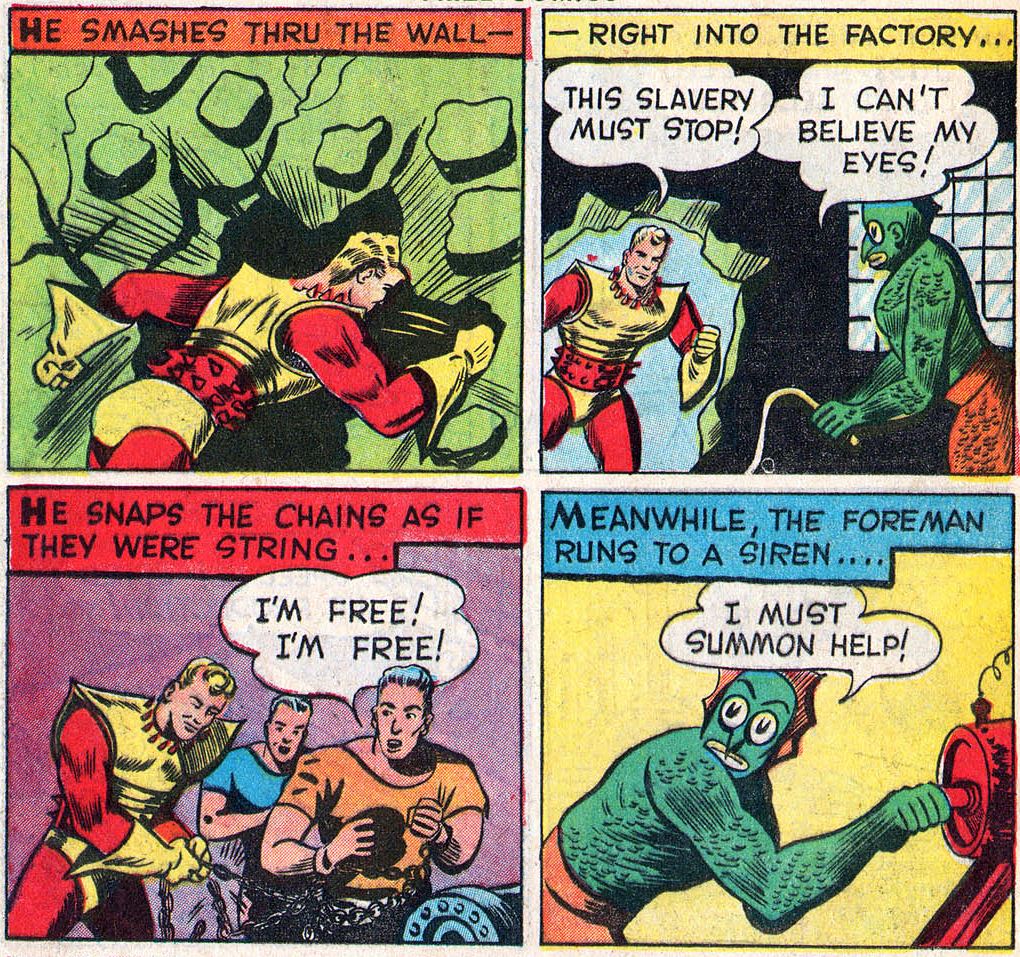
The men are of course disappointed to learn that they are effectively slaves, to the extent that none of them seem to notice the high-fashion look that their captor is sporting and how much is contrasts with the simple purple pants of the planet's leader. A bit self-involved, but who am I to judge?

Power Nelson of course does not abide this, and busts everyone free at the first opportunity. Note also the factory foreman's look - orange sunburst bonnets must be "in" on Uranus in 1982.


Power Nelson does not fight women and so Bloor's strategy to send his Amazon Regiment to capture him really pays off. But who are these Amazons? Is this what female Uranians look like or are they mercenaries from some other planet? Is this a sex thing for Bloor?


Power Neslon is of course held in place not by ropes but by the power of his own antiquated ideas about gender and he frees himself just in time to get attacked by some really excellent cylindrical robots that, alas, have no visible gender signifiers and are rendered into so much scrap.

Bloor is forced to release and pay the men, but in keeping with Nelson's dedication to preserving existing power structures suffers no further consequences. I do really appreciate how committed he is to his role as a manager of Uranus rather than a traditional dictator - he might just be our first villain who operates almost completely from a desk. 

The men all head home with a week's wages and I guess that that solves the financial crisis. Everyone is happy under the boot of Seng I. Thanks, Power Nelson!

Thursday, January 23, 2025

MINOR SUPER-VILLAIN 709: RACKO

(Prize Comics 002, 1940)

Though he went unnamed in his first appearance, this tonsured fellow is Racko, alien magic man Jupiter's most enduring foe at a whopping three encounters. Racko's first outing involved a classic pyramid scheme structure as he sent mutated green humans with horn noses out into the New York streets to kidnap more humans to turn into more minions, and so on until he controlled the world. Ironically, this might be a slightly more ethical version of the typical pyramid scheme, as his minions were under no illusions that they might eventually become wealthy if they sold enough tights or what have you.

A bunch of what turns out to be fairly dim-witted minions is just not enough to contend with a magic-using alien super-hero, even when bolstered by a paralysis ray cannon, and Racko is forced to restore his henchmen to human form before seemingly taking his own life via some handily exposed wires.


Racko fans need not despair, as it turns out that he survived! His new plan: drain all of the reservoirs that supply NYC until the Governor of New York is forced to bow to his demands for some ray gun plans and the Governor's daughter Joan.

(just why the Governor has these plans is not explored in the text, so we must assume that they are associated with the office. A gubernatorial death ray, as it were)

Perhaps in an overreaction to the poor showing that his monsterized henchmen put on in his last scheme, Racko uses the death ray on his own men after they secure it for him. They probably wouldn't have offered much assistance when Jupiter and his pal Jim Johnson show up at the volcano base immediately afterward, but even a useless henchman can serve as a distraction. As it stands, Racko ends up falling to his death in the depth of a volcano that is subsequently blown up by Jupiter. Gone for good, I'd say.

racko

I have called it too soon, as Racko is in fact not dead yet again and is taking another pass at world conquest, this time by launching "boulder storms" from his hideout at the South Pole, and here I think that I have some constructive criticism for him: mad science or no, attempt to conquer the world or no... stop attacking New York City first. You're sitting at the South Pole, man - chuck a few boulders at Australia to test out your equipment before you do the thing that you know will attract Jupiter's attention because he live in New York.


Jupiter sails through Racko's defenses as easily as ever, despite the best efforts of some unaligned ice dragons, and the third time proves to be the charm as far as blowing him and his entire operations to smithereens with alien magic goes. Good by Racko;

Wednesday, January 22, 2025

MINOR SUPER-VILLAIN 708: SOPHUS, THE MAD PHILOSOPHER

(Planet Comics 008, 1940)


Once again an adventure begins that most classic sci-fi way: Buzz Crandall and his gal pal Sandra are noodling around in space when they run smack into something, in this case a crystal sphere that houses the secret headquarters of Sophus, the Mad Philosopher.


I couldn't tell you what school of philosophy Sophus subscribes to, but it's one with an intellectual framework that encompasses a) turning other humanoids into mist and keeping them in bottles and b) freaking people out of their gourds by flinging them through a time portal into a crazy abstract weirdscape. Since Sophus is mad, perhaps he's just taking a philosophy dedicated to helping other improve themselves way too far? Or maybe he took a Philosophy 101 class in university and decided that that was all he needed to be insufferable about his evil interests forever, who knows.


As Sandra is flung into the timestream and Buzz attempts to rescue her, we get a passable rendition of 1960s Dr Strange-style psychedelia, only in the 1940s. It's pretty neat, though it does make me pine for what will eventually be.

Sophus is eventually undone not by the heroes of our story but by his own jerk nature, as his villainous cackling over Buzz and Sandra's doom is delicious-sounding enough to draw the attention of the Elipticoon, a "giant time entity" that was about to devour Sandra but instead opts for a delicious and attention-grabbing philosopher. All the jarred people are set free, the end.

Tuesday, January 21, 2025

MINOR SUPER-HERO ROUND-UP 036

Prize Comics time, bay-bee.

Power Nelson:


Power Nelson is from the far-off future year of 1982 CE, in which the world has been conquered by the Mongols, but the wink, wink, nudge, nudge kind of Mongols from 1940-1941 where they're actually supposed to be the Japanese (and for some reason the nation of Mongolia is fair game as far as Explicit Villain Status goes while Japan is still off the table). He has been given super strength by some surprisingly beefy scientists so that he might save civilization from oppression. Three things about Power Nelson:

1) I think that his first name might actually be Power. So futuristic!

2) I kind of want to give this series credit for not being too racist but the truth is that it is fairly racist but my senses have been dulled by exposure to the excesses of post Pearl Harbor depictions of the Japanese. 

3) Power Nelson is very bad at his job? Every issue sees him within striking distance of Emperor Seng I and while assassinating the top man isn't a guaranteed way to end a regime, it absolutely cannot hurt. Just punch him, man! (Prize Comics 001, 1940)

Jupiter:

Jupiter represents two distinct super-hero archetypes: the alien lawman sent to Earth to dispense justice and the magic-user, and as those are two of the more omnipotent origins that a character can have he goes through crooks like a hot knife through butter. The most important question about Jupiter is: was he called Jupiter back on the planet Jupiter or is he adopting a cool new name like a kid at camp? (Prize Comics 001, 1940)

K the Unknown:

Douglas Danville, wealthy playboy, takes to the crime-ridden ski slopes as K the Unknown, feared and hunted by ski crooks and ski cops alike. And presumably regular cops and crooks too, but he only had one recorded outing and it took place entirely within the bounds of a ski resort.

K the Unknown's one adventure involves embezzlement and murder among the officers of a college alumni group, possibly the perfect case for a wealthy playboy type hero.


K the Unknown is a great name but perhaps not a great super-hero name, so I can see why he only had on outing. Still, it must be handy to have a calling card that you can piss into the snow. (Prize Comics 001, 1940)

the Black Owl

It's hardly unusual for a Golden Age character to make one appearance and then disappear forever, but much more unusually while K the Unknown never had a second adventure his alter ego Doug Danville just kept on trucking under another identity. It's never explored in the text of the story, so any explanation for why he made the change is an equally valid bit of speculation, from "he wanted a less generic super-hero identity" to "it's completely different guy named Doug Danville who hangs around with a completely different private eye named Terry Dane." It turns out that I wrote that last bit prematurely, as in the Black Owl's second outing his foe is Sigmund Rathko, the crook who was also behind the alumni association shenanigans in the K the Unknown story. I suppose that it could be three completely different people but no, at that point we're getting silly.

One thing that you can say for certain is that he didn't change identities to get the cops off of his back, because they want to get the Black Owl just as much as they did K the Unknown. Moreso, honestly, because K the Unknown was safely carving powder and never even saw a cop. (Prize Comics 002, 1940)

Monday, January 20, 2025

MINOR SUPER-VILLAIN 707: PRINCE BLAGA DARU

(Planet Comics 005, 1940) 

Gale Allen was a long-running feature of Planet Comics, which meant that she was a creation of many absent-minded hands. She is always an officer in a gendered space organization, but whether that is the Women's Space Battalion, the Girl's Patrol, the Girl's Squadron and so forth varies from issue to issue. The story is set in the far-off year of 1990 but drifts farther into the future over time. She turns blonde eventually. You get the picture. 

Early Gale Allen stories feature spaceman Jack North as a real pill of a sidekick who spends much of his on-panel time carping on about how women don't belong in the space military. They also feature Prince Blaga Daru, a space pirate-turned-world conqueror who has the hots for Gale, possibly because she is semi-secretly a Venusian princess but possibly just because he likes a strong woman.

In his first appearance, Daru has already conquered Europe and set his eyes on invading North America, with Step I of his plan involving taking control of the the Sub-Oceanic Transit Tube, aka the Trans-Atlantic Subway. Gale Allen and her Falcon Squadron set out to stop him, and shockingly don't succeed! That is, they do succeed in driving off the initial attack and then get captured by the Prince's special Gale Allen task force, for you see he loves her and wants to marry her. She of course tells him to go screw and gets away with the help of Jim North.

(the Prince's world domination scheme is kiboshed in the subsequent issue and Blaga Daru himself is punched in the eye for his trouble)


Prince Blaga Daru makes two more spends his next two appearances, in Planet Comics 009 and 011, and in both he has shifted his focus almost entirely to the pursuit of Gale Allen's hand in marriage. But not by reforming and being a cool guy and courting her on her terms, no. Prince Blaga Daru is a space pirate, and space pirates kidnap their love interests and marry them against their wills. It's a real culture clash, and it ends up with the Prince unceremoniously falling out of a spaceship door to his demise.

Sunday, January 19, 2025

MINOR SUPER-HERO ROUND-UP 035

Planet Comics how I love you, cobbled-together pile of scraps that you are.

Torro:


In an adventure that I can only assume was concocted in order to use up some extraneous art, Captain Nelson Cole of the Solar Force travels to the distant planet Zog and ends up taking up the mantle (and magic whip) of the hero Torro in order to help recover the planet's treasures from an evil giant.


As befits a personality that is probably just, again, repurposed art from an unused fantasy comic, Cole adopts the Torro identity completely. Using his magic clothes, boots, belt and whip, he battles and ultimately kills the two-headed giant and his one-headed wife and then goes back to being a spaceman. (Planet Comics 002, 1940)

Amazona the Mighty Woman:

Amazona belongs to a pre-Ice Age civilization that is not advanced so much as stubborn in that as the ice advanced on them they just toughed it out until the only ones left were super strong and immune to cold.


Amazona is understandably bored of the endless expanses of ice and snow afforded her and decides to tag along when reporter Blake Manners passes through following a shipwreck. In their one adventure together back in the US, Amazona gets to beat the tar out of a bunch of gangsters while wearing a party dress and I'm pretty sad that there wasn't more of this. (Planet Comics 003, 1940)

Jim Giant:

Jim Giant, billed as both the Strongest Man in the Universe and the Mightiest Man on Earth (both can be correct, in the right order), is super strong and super tough and in his single recorded adventure he beats the stuffing out of an entire invasion force that sweeps down from the Arctic. (Planet Comics 004, 1940)

Fero, Planet Detective:

I'm going to call it: Fero, Planet Detective started life as an unused Zero, Ghost Detective story that found its way from Quality Comics to Fiction House and was altered just enough to be distinct. Scrub out the Z and add an F, swap "Ghost" for "Planet" and most importantly slap an extra line on the text box about how all the werewolves and vampires are actually from Pluto. It's seamless!


I actually unironically love the first Fero adventure. It's a great example of how restriction and constraint can make for the most weird and creative choices. "Occult Detective" is after all an entertaining and rich subgenre, but "Occult Detective But All of the Monsters Are Also Space Aliens" is the sort of wild and wacky stuff you come up with while trying to pad out the pagecount of your science fiction comic book and all you have is a second-hand story about vampires and goblins. It's great stuff!

Sadly, though Fero continued to appear in Planet Comics for three more issues the occult aspects of his adventures fell by the wayside in favour of more traditional space detective cases - space theft, space kidnappings, etc. It's a real blow for fans of occult sci fi.

Fero's remaining adventures are all right, but nothing to write home about. He does have a fun futuristic high-collared shirt, so that's something, but the most interesting thing about his latter adventures is his selection of transformation pills that he uses to get out of  scrapes, including one that turns you into a toddler and the amazing one that he is taking above to turn into a rampaging anthropoid. (Planet Comics 005, 1940)

SUPER-VILLAIN FILE 003: NAMOR THE SUB-MARINER

(Marvel Comics 001, 1939*) No character in comics history swings more wildly and frequently between super-villain and super-hero than Namor ...