Wednesday, March 12, 2025

MINOR SUPER-VILLAIN 741: THE MASKED ONE

(Smash Comics 007, 1940)

Sometimes a villain is as simple as a hooded gun-runner called the Masked One, and that's who we have here. Also, he is captured by Quality Comics adventure character Abdul the Arab, a name that isn't technically problematic but sure does make the corner of your eye twitch when you read it (plus the comics it appears in meet all the problematic specifications, so your eye is right to react).


The Masked One is actually Webb, a character who could not be more clearly signposted as the prime suspect if his name was Eno Deksam but who elicits the same amount of surprise when unmasked as Abdul's own mother might. Perhaps he was just giving the Masked One the benefit of the doubt in not assuming he'd be so obvious.

Tuesday, March 11, 2025

MINOR SUPER-VILLAIN 740: THE DEATH BATTALION

(Smash Comics 007, 1940)


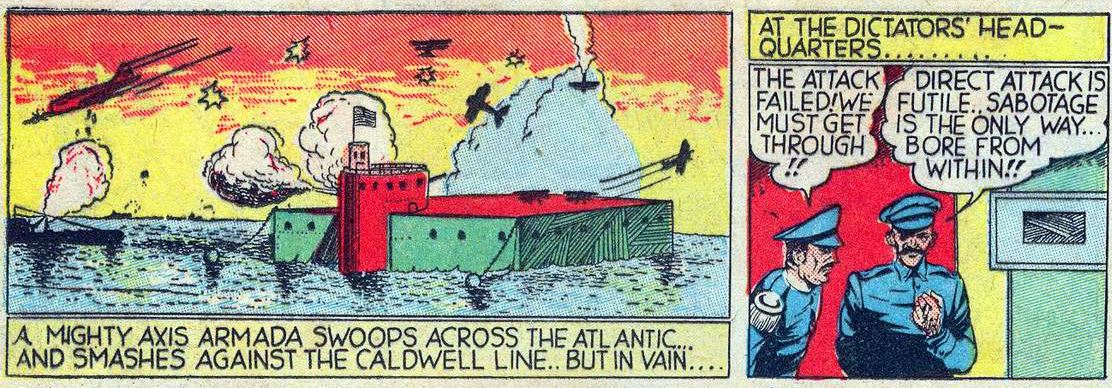
You're going to have to trust me because I have gathered no evidence, but I can state with some confidence that the American people of late 1939/early 1940 had a great deal of (perhaps wishful) hope in the effectiveness of the French Maginot Line, right up to the point at which the Nazis did an end run around it and into France. A fair number of war comics of the time (like the adventures of Corporal Collins, for example) feature defenses of the Line (or fictional versions of the Line) from the advancing Axis. Perhaps the most interesting version of this Maginot Line fandom is the concept of the US defending itself via "the Caldwell Line," a series of floating fortresses running from Canada to Tierra del Fuego, if the caption box is to be believed (the floating fortress is another frequently referenced Golden Age idea that I have no other examples of beyond "dude, trust me").


The Axis powers (still creeping up to the line of just saying Nazis) respond to this defensive superiority by deploying their finest spies, under the leadership of Madame la Coquin here. And since the greatest enemy of the spy in America is Black X (in a Black X comic, at least), la Coquin and her cadre start their campaign by hatching a plot to kill him.


As is usually the case in plots to preemptively murder the protagonist of a comic, this proves to be a very bad idea. The Black X manages to fake his own death with the help of a handy psychic illusion (courtesy of his aide Batu) and uncovers the whole operation, namely a secret underground base from which Madame la Coquin and her Death Battalion comrades plan to attack the Caldwell Line using manned torpedoes. An insane plan!


Black X manages to foil the suicide runs of the first two Death Battalion members by radioing their positions to the US Coast Guard, but finds himself unable to do so when la Coquin takes out the final torpedo herself, because they are very horny for one another. And he almost saves her! Oh Black X, are you ever going to find love in the arms of someone who isn't an enemy agent?

(in one of my patented unproveable theories about comics published before my father was born, I reckon that la Coquin was originally going to be our old friend Madame Doom but they didn't want to blow her up)

Monday, March 10, 2025

MINOR SUPER-VILLAIN 739: THE AVENGER

(Smash Comics 003, 1939 - Smash Comics 012, 1940) 


The Avenger is a cottage-industry villain, which is a term I just made up for particular kind of villain that you saw a fair amount in the Golden Age and then again in 1980s cartoons, wherein battling and thwarting them is the sole focus of a hero's career - see also Mr H and the Conqueror.

The Avenger is also a revenge-focused villain: he is really Jim Rowan, a man who was swindled out of an unspecified invention decades earlier and now seeks to ruin and murder the thirteen men who did the swindling and have since grown wealthy off of it. This is a pretty reasonable motivation for revenge, and the Avenger might even have managed to come across as a somewhat sympathetic figure if he gave even one single damn about who else he might harm or kill in pursuit of his quest. His various schemes:

- bankrupt airline owner Carter by blowing up his passenger planes mid-flight

- murder electric company owner Amos Reid and frame his son George for the crime

- ruin railroad owner Edgar Karr by wrecking his trains

- incite mob violence against drug manufacturer Roger Carlin by tainting his products and distributing them to the poor

- just some low-effort murder attempts against group member Albert Mills

- ruin Rolls the bus company owner by stealing his buses, passengers and all 

- attempt to murder industrialist Roger O. Gates directly (but mistakenly kill a man who looks like him)

- blow up the munitions factory of Mr Arms

There's also a threat by the Avenger against nonspecific industrialist Albert Lewis that turns out to be bogus because Lewis has been imprisoned and impersonated by Rowan/the Avenger in order to aid his plan to destroy the others. The "death threat" is in actuality a ruse to get detective John Law alone and kill him. This leads to the discovery of another revenge scheme:

- lock Albert Lewis up in an insane asylum and take his place while acting as the Avenger, thus not only framing him but leaving him somewhere where he can't even tell anyone about it or be counted as even more insane

None of these schemes actually succeed, however, because the 13 men have hired scientist/lawyer/detective John Law (aka the Scientective) to discover just who is targeting them and why. Like fellow Henry Campbell creations Wizard Wells and Dean Denton, Law is a scientific genius who uses his knowledge and inventions to further his crusade against crime. He never quite gets ahead of the Avenger, but he's cagey enough to thwart his schemes before they can reach murderous fruition. Except for Amos Reid's murder, of course, because that was the first step in a plan to ruin Reid's legacy. And that one innocent man who died, that was a shame. The dozens of people who died on Carter's planes don't count, of course, because that happened before Law was hired. Look, the important thing is that twelve wealthy men were saved from facing the consequences of their actions.

The Avenger/John Law stories are entertaining stuff but nothing to write home about, mostly because both characters tend to employ what was cutting-edge or unusual science c.1940 that today is either unremarkable (remote controlled aircraft, thermite, dry ice) or is still a bit sci-fi seeming (magnetic levitation, increasing the skin's permeability via ultrasound) but all of it is applied in this very dry, matter-of-fact, everyone-is-wearing-a-suit way that drains some of the wonder and majesty from the proceedings.

A couple of interesting things about the Avenger:


The Avenger isn't a habitual costume wearer but he does throw on a hood a couple of times and I thought I'd showcase that. I prefer the red one!


This deathtrap, which involves a rapidly-spinning propeller and a strobe light synched to its movements to create the illusion of a stationary bar, is very fun and unique! Strobe lights! Very futuristic!

Also fun: Law's method for discovering the identity of the Avenger. He has thirteen phone lines installed, each with its own unique number, and gives one to each of his thirteen suspects. He then issues a provocative statement to the press and simply waits to see which phone rings when the Avenger calls to yell at him. This is, frankly, an amazing hack for any situation involving multiple suspects.

I can only assume that the Avenger's death came as a direct result of the series being discontinued - John Law, up to this point a fairly nonviolent man, abruptly shifts gears and blows the villain out of the skies with his own drone bomb. It's an ignominious end to be sure.

REVENGE KILLER SCORE: 1/13 - a pretty poor showing, due mostly to the Avenger's desire to draw out his targets' suffering. If he had gone for the kill straight away he might have done a bit better.

Sunday, March 9, 2025

MINOR SUPER-VILLAIN 738: KADU-KAN

(Smash Comics 006, 1940)


Time for a very obscure character indeed: Kadu-Kan, who put out Black X's eye in an attempt to induce him to spill some military secrets. Kadu-Kan is therefore a major figure in the history of the character to be mentioned in one panel and never again, and then only to provide a reason for Black X's ever-present monocle.


(Speaking of Black X and setups with no real payoff, the first Black X adventure in Feature Funnies 013, 1938 includes this enemy spy who is a double of Black X and escapes into the night at the end of the story, to never return)

Saturday, March 8, 2025

MAD AND CRIMINAL SCIENTIST ROUND-UP 016

Can't keep 'em down for long, these guys.


Look, breeding up a giant amoeba in order to use it to spread terror and conquer the world is one thing, but deliberately going out of your way to feed it "pretty girls" is some real twisted incel shit. It's a wonder that Dr Jorgen here just ends up in jail and not in the belly vacuoles of his creation. (Science Comics 006, 1940)


Dr Borgia is a weird creep who becomes... infatuated? obsessed? with Marga the Panther Woman during a period in which she is working at a circus in the US. Stung by her rejection of his creepy overtures, Borgia conspires with the owner of a rival circus to kill Marga by using the same technique that von Dorf used to give her the power of a panther to give a tiger the added power of a lion, thus making it too powerful fro her to defeat.

(and how galling for the ghost of von Dorf to see that Borgia knows his secrets after dying in a fire he caused while trying to burn that very information)

Marga is of course more than a match for even a tiger with the proportionate strength of a lion and proceeds to murder not only it but Borgia and his associate Randler. She also gets so fired up by this process that she acquires a kind of feral vampire-from-Buffy look that may not ever appear again.  (Science Comics 006, 1940)

With a thesis like "I reckon that humans won't do well when deprived of water," Bulvo here isn't exactly pushing the boundaries or even basics of science. It's just as well that the Eagle ends up blowing him up as he tries to destroy NYC's water supply, as he would have been eviscerated in court, not to mention the mad scientist trade shows. (Science Comics 008, 1940) 


Like his nemesis Iron Vic, Dr Spagna here suffers from the fact that the sole story in which he appears is incomplete. What we do know about him is that he used to work with Vic's benefactor Professor Carvel and possibly even on the very serum that Carvel used on the near-corpse that would become Iron Vic, but Spagna was too eager to share his findings and ended up being laughed out of scientific society. This is a common origin story for evil scientist types, but Spagna seems to have taken it harder than most and has been sowing murder and chaos throughout New York City even before the plot outlined in his letter to Vic above.

Iron Vic manages to foil 2/3 of Spagna's plot before the adventure is cut off, never to be resumed (as far as I can tell). Presumably, Vic prevented the bombing of Jefferson Square Garden and brought Spagna to justice somehow, but if that involved further hints or revelations about Vic's past, we will seemingly never know. (Single Series 022, 1940)

Friday, March 7, 2025

MINOR SUPER-HERO ROUND-UP 041

Another assortment of guys for your delectation.

the Sky Wolf:

Just another masked pilot in a souped-up named plane (originally the Silver Bullet, followed by the Golden Bullet), the Sky Wolf loses both his place in Silver Streak Comics and his plane's name to fellow pilot Cloud Curtis once 1941 rolls around, and to add insult to injury, in 1942 the far more successful character of Skywolf debuts over at Hillman, ensuring that he doesn't even have good SEO. (Silver Streak Comics 004, 1940)

Whiz, King of Falcons:


The Silver Streak is not immune to the sting of pride, so when aviator Sir Cedric Baldwin challenges him to a race around the world to prove who is the fastest man on Earth, he accepts, and is of course fast enough that he not only wins but is able to have a very culturally-sensitive adventure in Saudi Arabia along the way. Silver Streak is knocked out and captured at one point, and the falconry-obsessed villain takes advantage of this to inject his favourite bird with some super-fast blood. 

Astonishingly, this works, despite our only account of the Silver Streak's origin being as a result of hypnotic conditioning coupled with a near-death experience - perhaps the hypnosis was so deep that it mesmerized his very blood? That would explain the falcon's immediate shift in loyalty from its owner to its super-heroic blood doner, at least.

"Whiz, King of Falcons" is technically not this guy's name until Silver Streak Comics 007, which was published in 1941, but I reckon that calling him "Unnamed Falcon Companion" here and then correcting it in six months' time would be extremely wilfully obtuse of me. (Silver Streak Comics 006, 1940)

UPDATE 1941 

the Daredevil:


The Daredevil is Bart Hill, a vigilante in the Batman mould, having lost his parents to a gang of crooks and subsequently vowed to revenge himself on crime. Further, those same crooks tortured Bart himself, rendering him mute in the process, and due to a boomerang-shaped brand they left on his chest he devoted himself to the study of the weapon, adopting it as one of his heroic signatures. The Daredevil is one of the longer-running non-Marvel or DC/Fawcett/Quality characters of the Golden Age so he will be making a few appearances here going forward, but there are a few notable things about him:

- his origin will undergo some revision between his first and second appearances, most notably the fact that his muteness is discarded - presumably to enable for easier storytelling

- his costume is also somewhat revised, which is fun particularly because, like his Silver Age namesake, he switches from a yellow to a red colour scheme

- this Daredevil's Golden Age popularity, combined with his public domain status, means that he's a popular choice for modern revivals, but the fact that there is a currently-published character with the same name (and owned by Disney, to boot) means that nobody dares to actually call him Daredevil in their stories and so the more recent versions of him have a wide range of variably terrible alternate names including the Death Defying 'Devil, the Daring Devil and Doubledare. (Silver Streak Comics 006, 1940)

UPDATE 1941 

Iron Vic:


Iron Vic is a frustrating beast. He first appears as a mostly-dead body washing up near the island laboratory of Professor Carvel, who applies a "certain rare serum" to the task of saving his life before dropping dead from the strain. Vic, as the man comes to be known, is rendered both amnesiac and superhuman by the process. He has one proper super-heroic adventure against Carvel's old colleague Dr Spagna before the strip transitions into one primarily about baseball (and in case you're wondering there is no mention of the ethical quandary that a superhuman participating in regular human sports would cause). The really frustrating part is that Dr Spagna implies that he knows something about Iron Vic, but the Spagna story is never actually resolved anywhere. Vic is merely an amnesiac baseball player until I think he enters the Army at some point? WHERE OH WHERE IS MY RESOLUTION (Single Series 022, 1940)

Thursday, March 6, 2025

MINOR SUPER-VILLAIN 737: THE SPOOK

(Silver Streak Comics 006, 1940) 


Continuing from the story of the Panther, Ace Powers ventures into the hole he had left the villain and his Panther Men in, seeking to discover the location of the former and presumably the reason for the deaths of the latter. Making his way through a concealed door, Powers finds the Panther about to be executed by a third villain called the Spook, who states that he is doing so because the Panther failed him, presumably by being foiled by Ace Powers in the previous issue. And let me tell you: I almost always love the revelation that a super-villain is in fact merely an agent of an even more evil villain but I especially love the fact that this means that the Panther Men were essentially subcontracting villainy.

The Spook captures Powers with the help of his rad Skeleton Men and of course offers him the chance to join up with an organization where failure will get you gruesomely killed (it's an understandable no from Our Hero). He also lays out his deal, kind of, and this is where we get into the very frustrating thing about the Spook: he's clearly a vampire, but this comic won't just come out and say it. Check it out: sharp canines, lives underground, "my body cannot stand sunlight." Even that mantled robe he's wearing is pretty reasonable comic book vampire fashion for the early 1940s.


Plus, there's the Skeleton Men, who are again rad as hell and are described as being animated by the Spook's will alone (yes, he says "hypnotic" there but really that's about the same as describing your power as "quantum" in a comic from 2010 only for magic). That's some vampire shit right there.

Ace Powers manages to knock the Spook out with a solid right to the jaw, which disables the Skeleton Men as well - this raises some questions about how security works while the Spook is enjoying a nap, or it would do if he weren't clearly a vampire.

To cap off the frustration, Powers decides to rid the world of the Spook with a simple bundle of dynamite rather than for instance dragging him out into the sun to shrivel up, a clear violation of my right to see vampires shrivel up in the sun from time to time. It's a good thing that this is your final appearance, Ace Powers, because I now have a grudge against you and I would hate to have that taint my reading experience going forward.

BIG-TIME ANNOUNCEMENT

It had to happen, and now it has: I made a real-deal website, aka a Wordpress blog that is as close to this as possible. Find it at theskele...