Saturday, February 22, 2025

REAL PERSON ROUND-UP 010

The wartime exploits of the original Wizard, expressed as a series of encounters with famous figures from US history. 

Benedict Arnold:

Very nearly captured by the original Wizard. (Shield-Wizard Comics 001, 1940) 

General Charles Cornwallis:

Defeated by a coalition of the Americans, French and the original Wizard. (Shield-Wizard Comics 001, 1940)

Admiral François-Joseph de Grasse:

Helps defeat the British fleet at Chesapeake Bay but of course he couldn't have done it without the original Wizard. (Shield-Wizard Comics 001, 1940)

George Washington:

Wins the American Revolutiion with the help of the original Wizard. (Shield-Wizard Comics 001, 1940) 

General Horatio Gates:


Aided by the original Wizard at the Battle of Saratoga. (Shield-Wizard Comics 001, 1940)

Colonel Johann Rall:

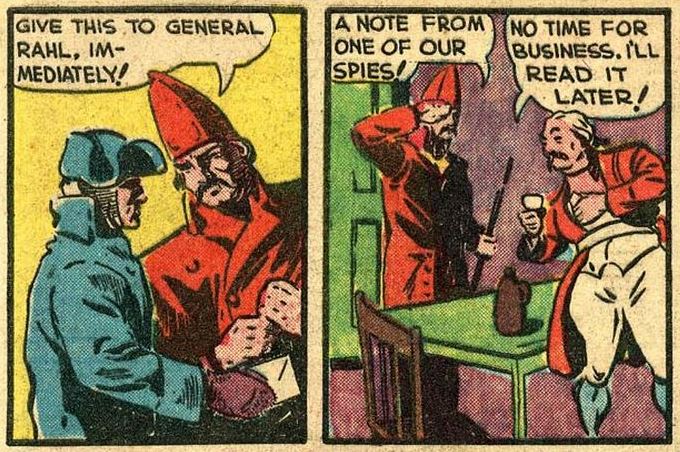
The commanding officer in charge of the Hessian mercenaries famously defeated by Washington after the crossing of the Delaware, Rall (or Rahl, as here) supposedly did really ignore news of the impending attack to drink and play cards. (Shield-Wizard Comics 001, 1940)

Major John André:

Major André, head of British military intelligence in the Revolutionary War, captured thanks to the original Wizard. (Shield-Wizard Comics 001, 1940)

Mad Anthony Wayne:

Slightly less mad than in out timeline due to having the original Wizard with him when he charged the British (Shield-Wizard Comics 001, 1940)

the Mayflower:

I'm willing to bet that if I track the fictional ancestors of comic book characters who are said to have come over on the Mayflower then I will probably end up with a passenger list larger than the actual one. Our first entrants are two ancestors of Blane Whitney, aka the Wizard, and both named John. The younger of the two also organized the mythical first Thanksgiving, to boot! (Shield-Wizard Comics 001, 1940)

Nathan Hale:


In maybe the dumbest bit of American myth-making in the whole saga of the original Wizard, he frees Nathan Hale from his pre-execution imprisonment only for him to choose to stay behind and die because he can presumably somehow see all of the stupid patriotism that people load him down with in the future. Like of course his final words of defiance mean so much less if he's essentially saying them and then blowing his own head off. Gah! (Shield-Wizard Comics 001, 1940)

Paul Revere:

Informed that the British are coming by the original Wizard (Shield-Wizard Comics 001, 1940)

Thomas Jefferson:

Knocks out the Declaration of Independence after the original Wizard intervenes in the battle of Concord. Also Samuel Adams is there shouting his own name. (Shield-Wizard Comics 001, 1940)

Friday, February 21, 2025

MINOR SUPER-HERO ROUND-UP 039

We're reading Shield-Wizard Comics, bay-bee, so here's some stuff about the Shield and the Wizard.

the Shield UPDATE:

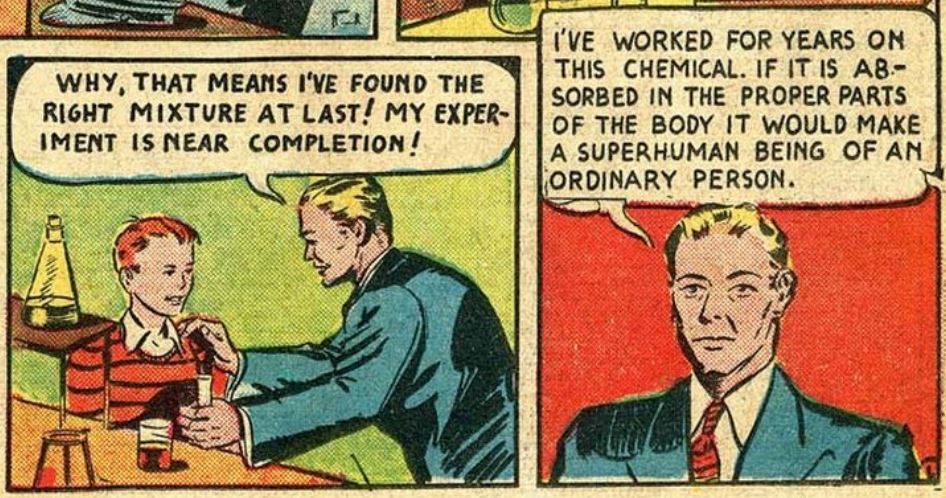
In our original write-up of the Shield, we noted that the origin of his powers shifted from being solely down to his super-suit to being more of an ingrained thing over time, and the time is now! Yes, Shield-Wizard Comics 001 provides a slightly tweaked version of the Shield's origin, in which Joe Higgins' father Tom was not just a US Army Intelligence agent but a gifted scientist who discovered the secret of inducing superpowers but died juuuust before being able to tell Joe the full secret.


Joe grows up to become a chemist himself but remains puzzled by his father's last instructions to remember "anatomy formula S•H•I•E•L•D," and with good reason, because it's a nonsense jumble of anatomical parts that must have been put together only in the specific medical textbook that Joe eventually finds it in. But hey, he needed to find out where exactly to rub the chemical formula, and how would he otherwise know that it boiled down to "your eyes and skin, but especially the skin over your chest and groin" without that handy mnemonic device?

The all-white costume that Joe is sporting before he settles down for a 12-hour session under the fluoroscopic ray shows up in at least a few retellings of the Shield's origin going forward and I always thought that it was a pretty snappy look. Unfortunately, the rays dye his suit (and possibly his limbs?) in patriotic colours and so we get a red-white-and-blue Shield rather than merely a white one.

The other tweak to the Shield's origin is that rather than merely dying in the Black Tom Explosion of 1916, Tom Higgins is blamed for it, so the Shield now not only has a Batman-style motivation (spies killed my dad and now I must battle espionage) but also a Geoff Johns-Barry Allen-Flash one (I fight crime as part of my attempt to clear my father's name). Thankfully, his first case involves rounding up the very German Hans Fritz and forcing him to confess, thus clearing Tom Higgins' name without it becoming a whole thing. (Shield-Wizard Comics 001, 1940)

the Wizard I:


In the original account of the Wizard's origin in Top-Notch Comics 001, the Whitney family's close connection to American history is pretty thoroughly emphasized, with Whitneys present and getting things done at all major American wartimes. Well, Shield-Wizard Comics took up that gauntlet and ran with it: John Whitney organized the Mayflower expedition, and his son John Whitney organized the first Thanksgiving, and his son or grandson John Whitney thought up the idea of uniting the colonies. 

But that wasn't all: the third John Whitney's son Blane (the main line of Whitneys only have time for three male names: John, Blane and Grover. All other named Whitneys are from dead end branches of the family tree, it seems) is just as super-human as his descendant, and in fact was the first of a line of Whitney family superhumans to call themself the Wizard (adopted as an ironic name after John Whitney was burned at the stake for witchcraft after acting on his son's extrasensory visions to protect the colonies).

The Wizard ends up making quite a big difference in the tides of the American Revolution, including:

- informing Paul Revere that the British were approaching Concord and lighting the "one if by land, two if by sea" lanterns

- showing up to participate in the fighting at Concord and turning the tide

- wielding a cannon as a sidearm in the Battle of Bunker Hill and again at the Battle of Saratoga

- saving Nathan Hale from being executed as a spy only not really because he chooses to die and be an inspiration instead

- orchestrating the crossing of the Delaware and the surprise attack on the Hessian forces

-very nearly getting Benedict Arnold before he gets away to join the British forces

- proving instrumental in the capture of Major André

- participating in several key battles, including the charge of Mad Anthony Wayne and the defeat of Cornwallis

- orchestrating the support of the French for the revolution


 This original Wizard also creates a number of anachronistic inventions, including:

- a glider that seems to function a bit more like a full-fledged airplane

- a steam powered speedboat

- something in between a deep sea diving rig and a scuba suit

- a machine gun

- radio communication

- an electrified, battery-powered suit

- a self-propelled sled

- a tiny high-powered cannon

All in all, the tale of the original Wizard holds up as a classic of the form, with the form being "super-heroes added to historical events." Comics love to showcase the great moments of US history in particular, but as a comic book must prioritize action, any super-heroic character who is present must have an extraordinary amount of influence on history. It's great! (Shield-Wizard Comics 001, 1940)

the Wizard II:


The second Wizard, like his father the original Wizard, is essentially a carbon copy of the modern character in appearance, name (Blane Whitney, natch) and abilities. Blane Whitney II also takes after his father in his commitment to inserting himself into important US historical events, including:

- participating in various military engagements, including the defeat of the HMS Gurrierre, the Battle of Lake Erie, the Battle of the Thames (I think?) and the Battle of Bladensburg

- saving William Henry Harrison from an assassination attempt

- almost preventing the burning of the White House by the British

- planning the defense of Fort McHenry and then participating in it

- accidentally enabling Francis Scott Key to get inspired to write the Star-Spangled Banner

This Wizard also has a lot of ahead of its time technology, including:

- a version of his father's glider

- smoke (possibly tear gas) grenades

- a dang tank

The second Wizard obviously has less of a direct impact on the events of US history, if only because the War of 1812 has fewer Stand Up and Cheer moments than its predecessor. Still, he's in there, and there's every indication that we'd continue on to see a Civil War Wizard and a World War I Wizard and so forth, and the stated reason that we don't see them is that as of Shield-Wizard Comics 003, the Wizard's sidekick Roy the Super-Boy was too popular to not feature and so it was contemporary Wizard from then on out. (Shield-Wizard Comics 002, 1940)

And speaking of Roy the Super-Boy:

Tommy the Super-Boy:

A part of any big project is choosing a methodology and then sticking to it and as my project is "reading all comics, in order" I had to figure out what "in order" meant. And while doing things in a month by month basis might be more true to the spirit of the experience, for my own sanity I opted to go alphabetical by year instead - the prep work alone for that other method hurts my head a bit to contemplate.

All that is by way of explaining that Tommy, "the Original Super-Boy of History" (aka the original wonder-boy according to that one panel) is a retroactively created predecessor of the Wizard's sidekick Roy the Super-Boy, who we will not meet until I have read the around 180 other comics between Shield-Wizard Comics 002 and Top-Notch Comics 008. He's your classic orphan kid who gets to hang around a super-hero because he's scrappy, and it turns out that that's not unheard-of in historical youths.

This particular scrappy kid, Tommy by name, is peeling potatoes when he meets an incognito Blane Whitney II and ends up discovering his secret identity after the Wizard participates in a sea battle and Tommy runs off afterward to berate Blane for cowardice, like a normal person does. And once you have discovered a super-hero's identity, you get to become a super-hero! If you are a scrappy kid, of course. (Shield-Wizard Comics 002, 1940)

Thursday, February 20, 2025

SUPERCUT: SKELETONS WITH JOBS

The Skeleton With a Job is a close cousin to the Looming Spectre of Death, only instead of merely lurking symbolically, they do a little task symbolically. I love them and they enhance every comic panel or splash page that they appear in.

COMMUNICATIONS:


Radio operator skeleton (Daring Mystery Comics 008, 1942)


Telegraphy skeleton (Daring Mystery Comics 008, 1942)

CRIME:

Gangster skeleton (Hit Comics 014, 1941)


Murderer skeleton (Mystery Men Comics 007, 1940)

Saboteur skeleton (Jumbo Comics 022, 1940)

MUSIC:


Conductor skeleton (Adventure Comics 068, 1941)

Violin skeleton (Feature Comics 035, 1940) 

SPORTS:

Football skeleton (Shield-Wizard Comics 002, 1940) 

Jockey skeleton (The Spirit Section, 29 December, 1940)

THEATRE: 

Puppeteer skeleton (Shield-Wizard Comics 002, 1940)

Stagehand skeleton, I think (Blue Beetle Comics v1 010, 1941) 

TRADES:

Not quite a skeleton but Blacksmith Skullhead can join the gang (Smash Comics 009, 1940)

TRANSPORT: 

Driving skeleton (The Funnies 047, 1940) 

 Pilot skeleton (Smash Comics 007, 1940)

Stagecoach skeleton (Adventure Comics 060, 1941) 

WAR:

Soldier skeleton (Crack Comics 006, 1940) 

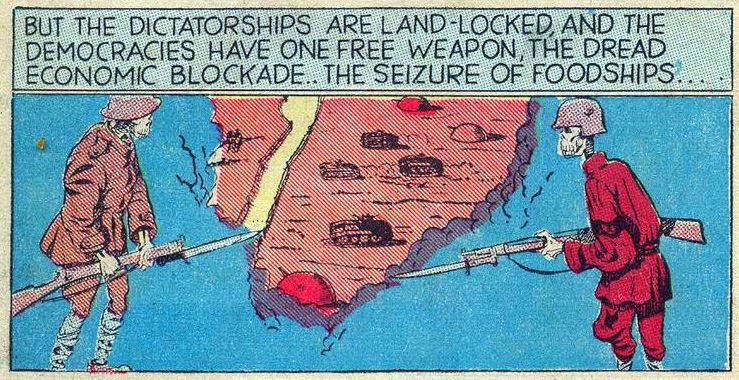
Allied and Axis soldier skeletons (Smash Comics 007, 1940)

Sort of a generic ancient warrior skeleton (Smash Comics 012, 1940)

Roman-ish warrior skeleton (Smash Comics 014, 1940) 


German soldier skeleton. (Wings Comics 002, 1940) 

Wednesday, February 19, 2025

PROBLEMATIC ROUND-UP 004

Get ready for a collection of MLJ's finest racially-problematic villains.

Yen Fat Sing: 

Yen Fat Sing's deal is that he knows about a treasure buried on Fu Chang's charity farm and, in an effort to grab that treasure for himself, has been murdering the workers using man-eating plants. He's a pretty standard type of minor super-villain but because he is a Fu Chang foe he is of course a generic Yellow Peril character on top of that. A couple of remarkable things about Yen Fat Sing: 

1. after all the effort to run everyone off the farm, once Fu Chang is closing in he just sneaks onto the grounds and digs up the treasure, suggesting that he could have done that all along and particularly so because nobody knew about the treasure at all until he ran his mouth about it.

2. Yen Fat Sing is killed in the course of the story but, unlike virtually every other comic book villain to have anything to do with carnivorous plants, he is not eaten by a tree but rather dies in a car crash.

I do rally like that the man-eating plants only attack in the dark. That's a fun detail. (Pep Comics 005, 1940)

Joodar the Evil:

Joodar the Evil starts out as an evil equivalent to Fu Chang, only instead of accessing his power via supplication to an ancestral god with a tonsure, Joodar worships the Great Genii of the Water Demons, and instead of a very eclectic set of animated chess figures...

... Joodar is granted the services of - you guessed it - water demons. Though his stated plans involve world domination, Joodar has a lot of trouble with step 1: destroy Fu Chang, to the extent that both the Great Genii and his Water Demon crew end up destroyed. (Pep Comics 006, 1940)


Joodar returns in the next issue, potentially because "summoning water demons" isn't a crime in San Francisco. This time he is without his demon pals and so he turns to the next best things: bacteria and mosquitoes! Specifically, he has mixed up a big batch of different harmful bacteria and stuck 'em in some mosquitoes in order to create havoc in San Francisco's Chinatown. Why does he do this? It's not entirely clear. Generic revenge? Mass chaos? Joodar doesn't really deliver a coherent thesis statement I'm afraid.


Joodar's greatest creation is this enormous mosquito, which almost takes out Fu Chang and his fiance Tay Ming but ultimately cannot contend with those pesky magic chessmen. Joodar, as far as I know, just absconds into the night - perhaps mosquito-crime is also not illegal in San Francisco. (Pep Comics 007, 1940)

Dr Wang:

Dr Wang is a Yellow Peril villain in the true Fu Manchu mould, a sinister genius who strikes at the security of the US for no stated reason. It's possible that we are meant to read Asian villain = Japanese, but if I'm honest an evil mastermind who plots against the United States for the sheer cussed challenge of it it quite a bit more evocative.

Dr Wang is so threatening to the secuirty of the country, in fact, that we are introduced to him in media res ad the Shield attempts to murder him by dropping a boulder on his car. This is that proactive super-hero action that we al1 wanted in the late aughts!

Dr Wang has two things going for him: the first is his mask, which looks great. Terrific style of mask, particularly with a hat. The second is his plan to disrupt US war production, by rounding up a bunch of guys who are afflicted with cholera and hypnotizing them into getting jobs in arms factories, thus starting a targeted cholera epidemic. And the very fun thing about this is that cholera is mostly spread by contact with infected feces, so these factories must be disgusting.

The Shield cannot of course let this stand, and goes back for another try at solving the Dr Wang Problem, and you know what they say: the second time is the charm - plus it's a bit more narratively satisfying for the Shield not to do a premeditated murder! (Shield-Wizard Comics 002, 1940)

BIG-TIME ANNOUNCEMENT

It had to happen, and now it has: I made a real-deal website, aka a Wordpress blog that is as close to this as possible. Find it at theskele...